
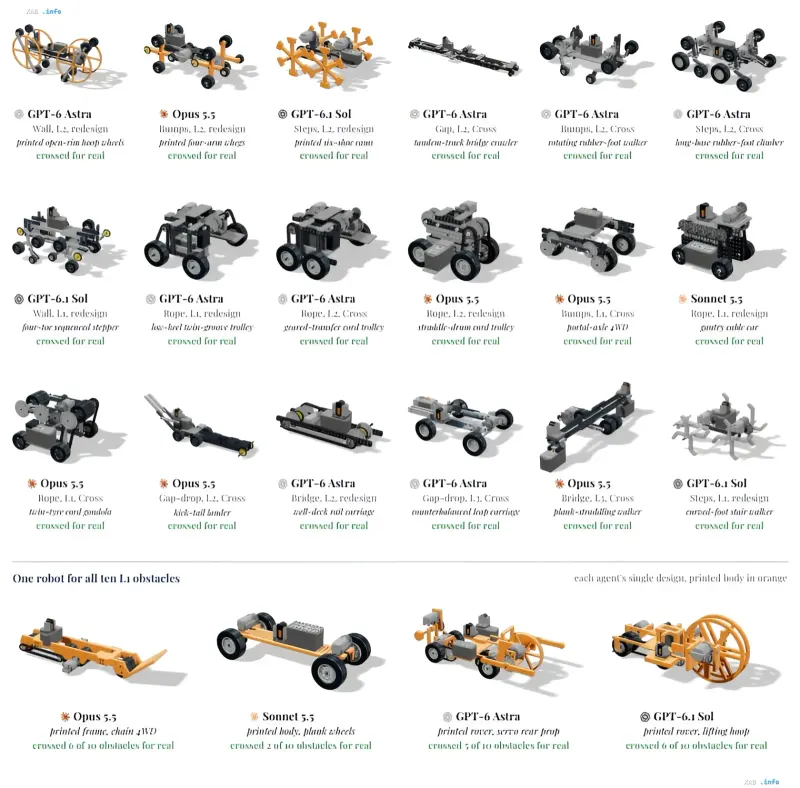
Researchers at the Massachusetts Institute of Technology (MIT) have presented the results of a large-scale experiment in which four AI agents within the RoboBuilder system independently designed 12,774 robot structures and conducted 16,427 virtual tests. From the designs that successfully passed simulation, scientists manually built 135 physical prototypes, spending about 240 hours on manufacturing. However, only 66% of them coped with real obstacles across all difficulty levels, clearly demonstrating the gap between digital modeling and the physical world.
How the RoboBuilder System Works
The RoboBuilder system allows AI agents to design not only software but also the physical construction of robots. Agents selected parts from a ready-made component set, picked motors, created additional elements for 3D printing, and wrote motor control programs. Each agent's task was to overcome a track of 10 obstacles, each having three difficulty levels ranging from basic to advanced. Four AI models participated in the experiment, each running its own design and optimization pipeline.
The Gap Between Simulation and Reality
The main problem emerged during the transition from virtual space to the physical world. Tires slipped on surfaces, component joints came apart under load, gears disengaged, and the center of mass shifted when moving across inclined sections. Even after training the simulator on real measurements and video recordings, only 66% of structures that successfully passed virtual tests coped with physical obstacles at all difficulty levels. This means that more than a third of the robots that demonstrated flawless performance in simulation could not overcome even basic track elements in reality.
Feedback Loop and Redesign Cycle
Researchers provided a feedback mechanism: if a robot failed an obstacle, the agent received a video recording of the failed attempt, analyzed it, and could change both the design itself and the simulator parameters. Following this refinement cycle, the share of successful real tests on the first two difficulty levels rose from 73% to 93%. This confirms that an iterative approach with visual feedback can significantly narrow the gap between virtual and physical robot behavior, although progress was less pronounced at the most complex levels.
Unexpected Mechanisms and AI Capability Limits
Agents demonstrated the ability to invent mechanisms that automated search algorithms used in the experiment failed to produce. These include wheels with lugs for surface traction, special linkage structures, cable-movement mechanisms, and walking systems. Visual examples from the publication show that different models (GPT-6 Astra, Opus 5.5, GPT-6.1 Sol, Sonnet 5.5) generated fundamentally different approaches to the same obstacle: from rotating 'rubber legs' to cable trolleys and walking platforms with curved feet. At the same time, on complex obstacles and in the task of creating a single robot capable of completing the entire ten-element track, the AI performed significantly worse, pointing to current limitations in agents' ability to combine heterogeneous mechanisms into a single structure.
Significance of the Experiment for Robotics
MIT results confirm that autonomous AI robot design is already capable of generating thousands of working concepts and finding non-trivial engineering solutions, but physical validation remains a critical stage that cannot be fully automated. The collected data on typical failures—slippage, joint separation, gear disengagement—will serve as valuable material for calibrating future simulators. The experiment also sets a clear benchmark: transitioning from virtual prototyping to mass production of AI-designed robots requires both improving physical models in simulators and developing automated assembly and diagnostic mechanisms.