The overwhelming majority of what we see in scientific publications under the headings 'exoplanet,' 'nebula,' or 'galaxy' is the result of modeling and interpretation rather than direct photographic imaging. The appearance of cosmic objects is born on supercomputers, where physical equations are turned into pixels. This is why the creation of new, more accurate models—especially for epochs of the early Universe, for which modern astronomy has practically no direct observational tools—remains one of the key tasks of theoretical cosmology. In this context, the work by scientists from the Massachusetts Institute of Technology (MIT) and their colleagues from other institutions takes on special significance: the Lumina simulation they presented recreates the first two billion years of the Universe's evolution with unprecedented resolution and volume for this class of tasks.
What is Lumina and Why is it Needed
Lumina is a large-scale computer simulation designed to trace how the first stars and galaxies formed from initial matter distribution inhomogeneities, as well as how the state of the intergalactic gas changed under the influence of radiation. The project aims to study the processes that brought the Universe out of the so-called epoch of cosmic 'dark ages.' As the first stars formed, the cosmic microwave background radiation, which previously served as the main source of information about the early Universe, shifted into the microwave range and lost energy, ceasing to act as a 'flashlight' for observers. Lumina makes it possible to fill this informational gap by modeling the transition from the dark era to the epoch of the first luminous bodies.
Computational Scale: 100,000 Cores and 15,000 GPUs
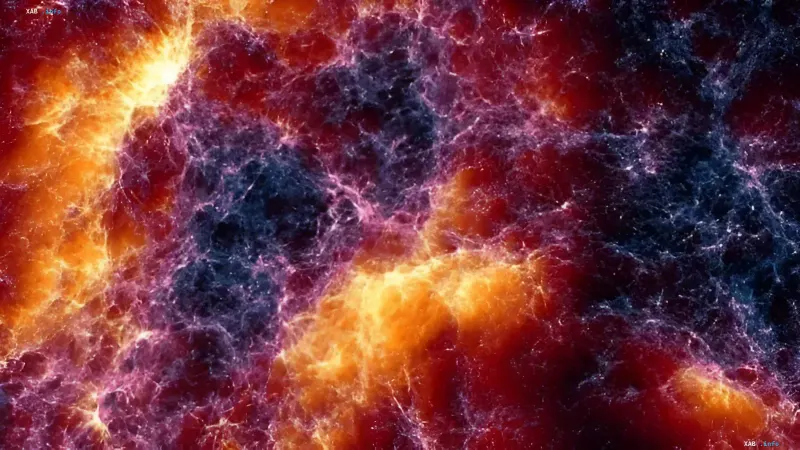
The calculations were performed on the Frontier supercomputer at the Oak Ridge National Laboratory (ORNL) in the USA. At peak load, the computations involved over 100,000 processor cores and about 15,000 graphics processing units. The simulation covered a cubic spatial region with a side length of approximately 1.63 billion light-years. The model includes about 432 billion elements representing dark matter and gas. According to the authors, the scale of the simulated volume is approximately 100 times greater than that of previous simulations intended for comparable studies. A visualization of the cosmic web published as part of the project demonstrates the structure in a region 650 million light-years wide.
Physics of the Early Universe in a Unified Model
Lumina is based on the advanced IllustrisTNG software suite, supplemented by a radiation transport simulation module. This makes it possible to simultaneously calculate the gravitational formation of large-scale structures, matter motion, star formation, and the ionization of the intergalactic medium. Particular attention in the model is paid to two key stages of cosmic history: the reionization of hydrogen driven by the radiation of young stars and galaxies, and the subsequent helium ionization, in which active supermassive black holes played a significant role. The authors emphasize that Lumina makes it possible to study these processes within a single model encompassing both the large-scale structure of the Universe and individual forming galaxies.
Connection to Observations: James Webb and Roman
The simulation results can be compared with data from the James Webb Space Telescope and the future Roman Space Telescope, allowing models of early star formation and galaxy evolution to be tested against observational data. Such an approach turns Lumina from an abstract computational experiment into a tool directly tied to current and prospective astronomical observatory programs.
Limitations and Open Access
It is important to understand that the simulation cannot be called a direct reconstruction of the past: it calculates the probable evolution of cosmic structures based on physical models and given initial conditions. Nevertheless, the authors note that the model will be fully open to the scientific community—expected starting in 2028—allowing researchers worldwide to use Lumina to test their own hypotheses and refine early Universe parameters.