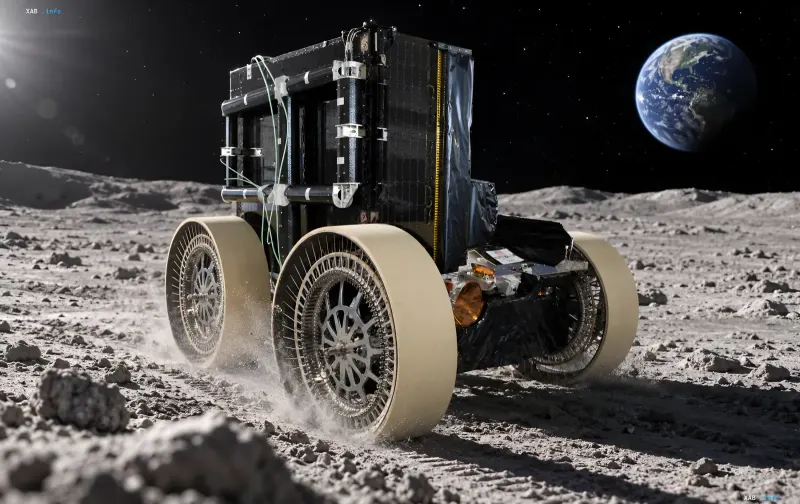
American company Astrolab is preparing to launch the FLIP unmanned lunar rover, which will deliver the first-ever space supercomputer designed for autonomous operation with artificial intelligence and graphical processors to the lunar south pole. The Spaceborne Computer-4 computing module, developed by Hewlett Packard Enterprise (HPE), will become a key element of the Griffin-1 mission—part of NASA's program to involve private companies in exploring Earth's satellite. The launch is planned under a commercial contract, and delivery of the equipment to the lunar surface will be carried out by Astrobotic's Griffin lander.
The FLIP Rover: Design and Purpose
The unmanned FLIP rover is engineered for year-round stay on the lunar surface. This means the vehicle will have to survive multiple lunar nights, each lasting over 150 hours of complete darkness at extreme low temperatures. Unlike previous lunar missions where equipment operated for only one or two lunar days, FLIP and its computing core are designed for multi-month autonomous operation without support from Earth. The rover is equipped with solar panels and rechargeable batteries that power all systems, including the supercomputer, during periods of solar day and darkness.
Spaceborne Computer-4: Computing Core for Vacuum
Conventional computers cannot function in space conditions: the lack of atmosphere rules out standard air cooling, while the radiation environment and temperature fluctuations destroy standard electronics. The HPE module is built using special technology: it is lightweight, designed as a solid monolithic block without fans, and protected by a sturdy aluminum housing that efficiently dissipates heat in a vacuum. Inside, it features an energy-efficient processor, a powerful graphics card optimized for artificial intelligence tasks, and reliable solid-state drives manufactured by KIOXIA. The main task of the equipment is to prove that modern computing architecture is capable of operating in the extremely harsh conditions of the lunar surface without any external maintenance.
Navigation Without GPS: AI as the Rover's "Eyes"
There is no satellite navigation system on the Moon, making it extremely difficult for rovers to independently determine their position. To solve this problem, FLIP will be equipped with a "smart" navigation program previously successfully used by NASA's Jet Propulsion Laboratory (JPL) on Mars missions. The algorithm works on the principle of visual recognition: artificial intelligence compares images from the rover's onboard cameras with photographs already stored in its memory. By finding familiar hills, boulders, or characteristic terrain features, the system accurately determines the rover's coordinates and plots a safe route bypassing deep craters and other obstacles. This approach allows autonomous movement across unfamiliar terrain without communication with Earth.
Delivery and Strategic Importance of the Mission
Astrobotic's Griffin lander will deploy the rover with the supercomputer to the lunar south pole—a region considered a priority for future crewed missions due to the presence of water ice in permanently shadowed craters. The Griffin-1 mission is implemented under NASA's Commercial Lunar Payload Services (CLPS) program, aimed at engaging private developers in lunar exploration. The successful operation of Spaceborne Computer-4 and the navigation AI on the lunar surface will be a direct step toward preparing infrastructure for astronaut landings under the Artemis program and establishing permanent scientific bases on the Moon. If the experiment succeeds, the collected data on the long-term operation of computing systems in lunar conditions will be used in designing the next generations of lunar and Martian spacecraft.