A group of researchers from Vilnius University and Utrecht University has launched an initiative to temporarily suspend the industrial exploitation of the Moon until the international community develops and approves a regulatory framework for such activities. In a paper published in the peer-reviewed journal Global Environmental Politics, the authors warn that rapid infrastructure construction and the initiation of resource extraction on Earth's satellite could cause irreversible damage to the lunar environment and destroy materials of exceptional scientific value for understanding the history of the Solar System.
The Rapid Race for Lunar Resources
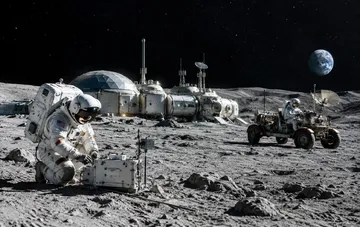
The urgency of the initiative is driven by the concrete plans of major space powers. The US and China expect to establish permanent settlements on the Moon by the end of the next decade, specifically by 2035. Commercial infrastructure is already forming around future expeditions: a number of companies are considering extracting water, construction materials, industrial metals, and rare-earth elements. According to the authors of the initiative, strict international norms and a broad public debate on the environmental and geopolitical consequences are necessary before this activity begins on an industrial scale.
«This Must Not Turn into the Wild West»
Professor of Climate and Technology Governance at Vilnius University Florian Rabitz and Assistant Professor at Utrecht University Xiao-Shan Yap are concerned not only about physical damage to the lunar landscape. The key geopolitical risk, in their view, is that the development of the satellite will end up in the hands of a limited number of influential states and their allies. Rabitz emphasizes that countries that build major infrastructure first will effectively be able to stake a claim to specific territories, even if they do not formally declare them as their property. «This must not turn into the Wild West», the scientist stated, referring to the lack of transparent rules for allocating operational zones.
The 1967 UN Treaty and Its Limits
The legal foundation of space activity remains the 1967 UN Outer Space Treaty, which prohibits states from appropriating the Moon and other celestial bodies. However, according to the researchers, this ban by itself does not guarantee that large-scale resource extraction will leave the satellite as neutral territory. Actual influence over specific regions could pass to those who possess the financial and technological means to build and operate lunar infrastructure. Thus, formal compliance with the treaty does not preclude the creation de facto zones of exclusive control.
Scientific Value That Cannot Be Restored
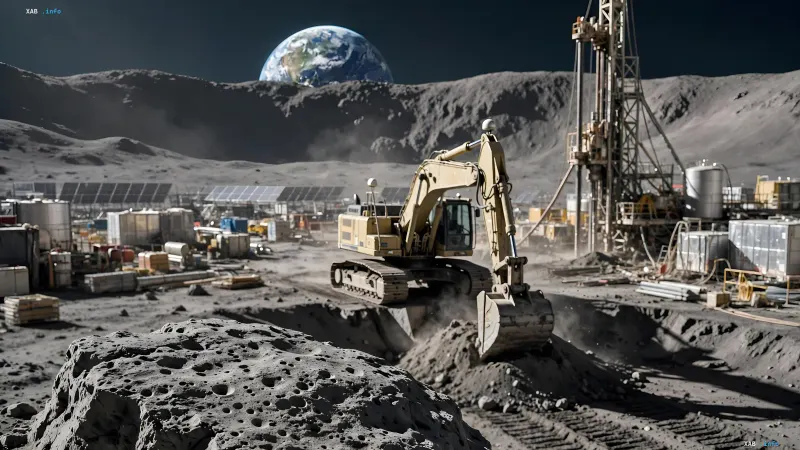
A separate argument from the initiative's authors concerns the irreversibility of potential damage. The lunar landscape contains unique geological and mineralogical samples formed over billions of years. Industrial extraction, base construction, and laying communications will destroy these materials irretrievably. Unlike terrestrial ecosystems, the lunar environment lacks the capacity for regeneration, and therefore any intervention is permanent. The scientists insist that a moratorium will provide time to conduct a comprehensive scientific assessment and agree on restrictions that will preserve the most valuable sites for future research.
What Next: The Path to International Norms
The proposal for a moratorium is not legally binding and serves as a scientific initiative. Nevertheless, its publication in a respected academic journal and the public discussion it triggers create the basis for including the issue on the agenda of international negotiations on space activity. Under conditions where the first commercial lunar missions are already in the planning stage, the window for developing agreed rules is limited. The authors emphasize that the earlier the negotiation process begins, the higher the probability that the industrial development of the Moon will not turn into an uncontrolled race with irreversible consequences.