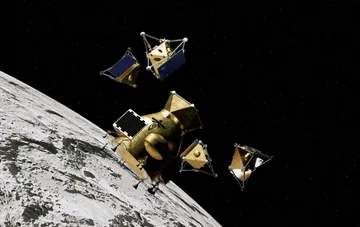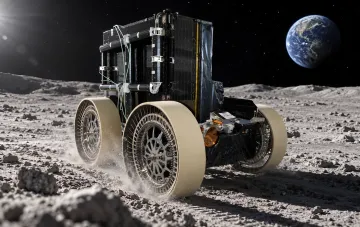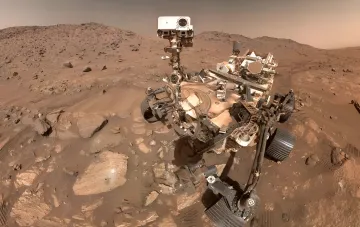
The vast distances between Earth and exploration targets make transmitting every command from orbit or a planet's surface virtually pointless: a signal to Mars takes anywhere from four to twenty-four minutes one way, and to the nearest interstellar targets, years. This is precisely why autonomous systems powered by artificial intelligence are shifting from a convenience to an engineering necessity. According to experts, AI is already operating with a high level of autonomy in uncrewed missions today, and in the near future, such systems will be able to independently prepare infrastructure on the Moon and Mars even before the arrival of the first astronauts. We are talking about a transition from the model of "human on Earth — executor in orbit" to a model where the onboard system makes decisions in real time without waiting for instructions flying across millions of miles of empty space.
Three Turning Points in the Traditional Paradigm
Scientists identify three key shifts that are fundamentally changing the architecture of space expeditions. The first is the transition from a tool to a cognitive partner: the machine ceases to be an unconditional executor of hardcoded commands and becomes a fully-fledged "colleague" capable of analyzing the situation together with operators or independently, building decision chains, and adjusting the plan during the mission. The second shift is complete operational autonomy: the need to transmit every maneuver, every orbital correction, or every choice of scientific protocol through a delayed communication channel is eliminated. Onboard systems act in real time. The third is AI-driven science: onboard systems are moving from executing pre-set calculations to generating their own hypotheses, planning experiments, and searching for biomarkers—traces of possible life on other bodies of the Solar System.
Explainable AI and Growing Trust
A key barrier to handing over full control to machine intelligence in the most critical scenarios has long been trust: the operator could not be sure why the system made a particular decision. The development of Explainable AI—artificial intelligence capable of verbally or in a structured form justifying the logic of every choice—significantly lowers this barrier. When a system can "tell" the operator on what data and through what reasoning chain it reached a conclusion, the level of trust grows, and the transfer of authority ceases to be an act of faith in a "black box".
Near and Distant Horizons of Application
In the near future, researchers believe, AI will be utilized for predictive maintenance of spacecraft—predicting component failures before they actually break down—ensuring autonomous life support on other planets, and providing medical assistance beyond Earth where the nearest doctor is minutes or hours away at the speed of light. In the more distant future, the mass deployment of robot swarms coordinated by a single intelligent system is expected, along with the creation of fully autonomous interstellar probes capable of flying for decades without any human intervention.
Challenges and a Shift in Expedition Concept
Despite the grand prospects, developers of autonomous space systems face significant technical and organizational challenges that prevent laboratory prototypes from being immediately transferred aboard spacecraft. Nevertheless, the general vector is obvious: the development of autonomous systems fundamentally alters the concept of space expeditions, turning them from missions coordinated by humans in real time into projects designed, launched, and executed predominantly by artificial intelligence. In such a model, the human shifts from the role of an operator to the role of a task architect and higher priority controller, while routine and tactical management completely transitions onboard.