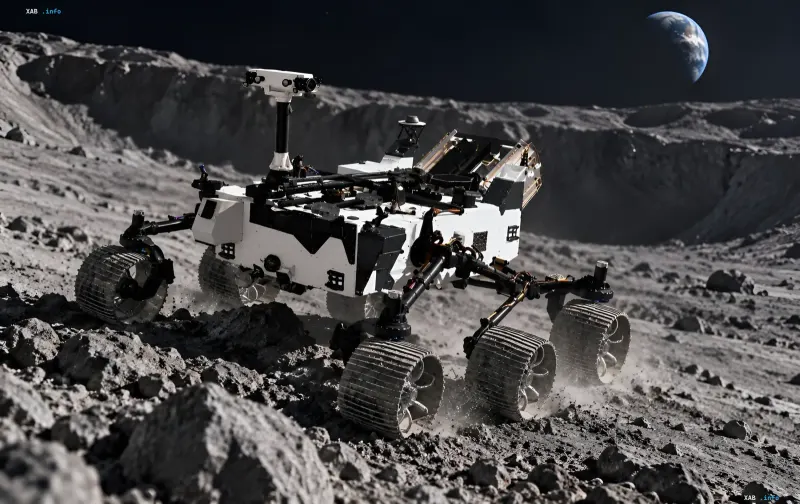
NASA's Jet Propulsion Laboratory is continuing work on the six-wheeled planetary rover PROMISE (Polar Roving MOdel for In-Situ Exploration) — a vehicle that is set to land in the region of the Moon's South Pole. A key feature of the project is saving time and budget: engineers are assembling the rover primarily from spare flight components and ground test equipment from the Mars rovers Curiosity and Perseverance, while part of the science payload is borrowed from the VIPER lunar rover. The launch is planned for the end of 2028, and delivery to the surface will be provided by Blue Origin's Blue Moon Mark 1 lander.
Assembly from "spare" Mars rover components
The rover's dimensions are about 2.9 meters in length with a mass of roughly 1025 kg. The running gear will be built on the basis of a rocker-bogie suspension, which has already proven its reliability in Mars missions. This approach avoids lengthy development from scratch: proven modules are transferred to the new vehicle, and engineers adapt them to lunar conditions. According to analysts at The Planetary Society, transferring ready-made components does not mean automatic compatibility — the systems will have to be re-tested for resistance to sharp temperature swings, fine electrostatic lunar dust, and the specifics of operating at the pole.
Why exactly nuclear energy is needed at the pole
At the Moon's South Pole, night lasts about 14 Earth days, and in some craters sunlight does not appear at all, so ordinary solar panels cannot ensure prolonged operation. Instead, PROMISE will receive a Multi-Mission Radioisotope Thermoelectric Generator (MMRTG), located in the rear part of the body. NASA emphasizes that this is not a nuclear reactor: the device generates energy through the natural decay of plutonium-238, which constantly releases heat. The generator will convert part of this heat into electrical energy — about 110 watts at the start of the mission — while the remaining heat will be used to warm the electronics, batteries, and mechanisms through liquid loops. Such power will allow the rover to operate in permanently shadowed craters and survive two-week lunar nights, when temperatures can drop below −129 °C.
Science payload: drill, spectrometers, and new systems
The rover's main instrument will be the TRIDENT drill from Honeybee Robotics, capable of penetrating 1 meter into the lunar soil to measure its temperature and strength. Along with the drill will work the MSOLO and NIRVSS spectrometers, as well as a neutron spectrometer — they will help detect hydrogen and analyze volatile substances to determine the presence of water ice and the possibility of using it. In addition, PROMISE will test a new space processor, the HPSC, and the Lunar Dashcam camera with floodlights for moving in the dark, created based on the cameras used during the landing of the Perseverance rover.
Delivery, timelines, and mission goals
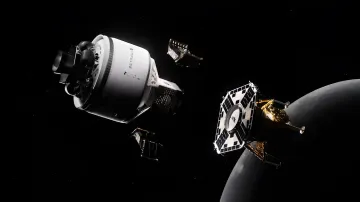
The primary mission is designed for 18 months. During this time, PROMISE will study the surface, map subsurface resources, and help determine safe sites for future astronaut landings. The vehicle will be delivered to the South Pole by Blue Origin's Blue Moon Mark 1 lander. NASA Administrator Jared Isaacman described the campaign as a step-by-step construction of a lunar base: "We are implementing a program to build a lunar base step by step, mission by mission… When our astronauts return to the Moon, the first elements of the lunar base will already be waiting for them on the surface."
Risks and mandatory checks
In addition to engineering tests of the suspension and systems for temperature swings and lunar dust, a separate stage will be nuclear safety checks, which must be passed before launching the vehicle with a plutonium generator. It is these procedures, rather than the assembly from ready-made modules, that may become the determining factor for meeting the launch deadline at the end of 2028.