Scientists have detailed for the first time how galactic cosmic rays reshape immune cells in the brain during long-term spaceflight. Research published in the journal Scientific Reports showed that radiation induces molecular changes in microglia cells of mice of both sexes, yet, at the testing stage, it does not lead to a massive inflammatory response or noticeable impairments in memory, cognition, or behavior.
Why the brain is vulnerable in space
Galactic cosmic rays are streams of high-energy particles traveling through space. On Earth, living organisms are largely protected by the atmosphere and the planet's magnetic field, but during missions to the Moon or Mars, astronauts will face the direct impact of such radiation. This is why NASA is studying how prolonged space travel can affect brain function. Professor of Neuroscience M. Kerry O'Banion, who has been working on this topic for over 15 years, noted that his previous work suggested space radiation could accelerate the development of Alzheimer's disease.
How the experiment was conducted
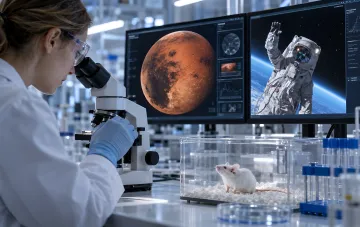
The new experiment was carried out at the NASA Space Radiation Laboratory at the Brookhaven National Laboratory. Using particle accelerators, researchers replicated cosmic radiation conditions and analyzed nearly 16,000 microglia cells—immune cells of the mouse brain—from both sexes. To evaluate the changes, they used single-cell RNA sequencing, which tracks how the function of each cell changes. The study was led by neuroscience graduate student Mark Osabutey.
Sex influences brain response
Radiation caused molecular changes in cells of both sexes, but the nature of the responses differed. In males, changes primarily concerned the cells' adaptation to stress and metabolism, while in females, the activity of immune signaling processes decreased. Furthermore, in the brains of both groups of mice, the levels of the FKBP5 protein increased in two areas—the cortex and the dentate gyrus; this protein is involved in regulating cell responses to stress.
What this means for Mars missions
For now, scientists are struggling to determine whether these changes are harmful to the brain, if they help it adapt to radiation, or if they are merely a temporary response, and what exact role the FKBP5 protein plays in this process. Future research should show how the brain is affected by different radiation doses and other spaceflight conditions. According to Osabutey, the results confirm that when assessing health risks for astronauts, it is important to consider biological sex, which will also help find ways to protect the brain during long-duration missions.