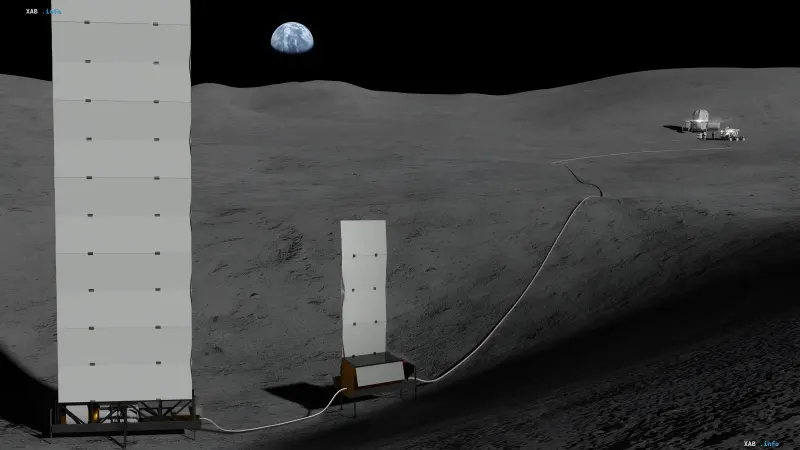
The U.S. space agency NASA has announced a competition to develop the first-ever nuclear power system for the Moon, dubbed the Lunar Reactor-1 (LR-1). This compact nuclear fission reactor is designed to deliver 20 kW of electrical power directly on the lunar surface. The agency aims to have a flight-ready system by 2030, with a requirement that it operates for at least five years once deployed on the Moon. Submissions from industrial partners are due by December 21.
What is the Lunar Reactor-1 Program?
The LR-1 is being developed by NASA’s specialized Space Reactors Division in collaboration with the U.S. Department of Energy (DOE). Beyond this primary program, the agency is open to additional orders for other space nuclear power systems. The Request for Proposals incorporates feedback received after a preliminary draft was published in August and follows industry meetings held in September. A mandatory requirement for the competition is that the reactor must comply with DOE safety standards for nuclear operations.
Why Nuclear Power?
Electricity is vital for the future lunar base, including living quarters, communication systems, rovers, and scientific instruments. The key advantage of a nuclear unit is its ability to produce power continuously, regardless of light conditions. The lunar night lasts 14 Earth days, during which solar panels cannot generate energy. The reactor will ensure power supply during this period, which is impossible to achieve with solar panels alone.
Statement from the Program Manager
According to Brian Gibilan, manager of the Lunar Reactor-1 program, a reliable source of safe and affordable power is essential for the long-term human presence on the Moon and for future Mars exploration. Unlike solar arrays, space-based nuclear systems can provide power to equipment in environments where sunlight is absent or insufficient.
Relation to SR-1 Freedom and Mars Plans
Simultaneously, NASA is developing the Space Reactor-1 (SR-1) Freedom project, scheduled for launch in 2028. The apparatus is intended to transport three SkyFall helicopters to Mars and demonstrate a nuclear-electric propulsion system, where the reactor powers spacecraft thrusters. LR-1 and SR-1 Freedom represent two pillars of a unified program aimed at developing nuclear propulsion systems for deep space missions.
Importance for Space Exploration
The collaboration between NASA and the U.S. Department of Energy on these complementary projects forms the backbone of a long-term strategy to provide energy for both crewed and uncrewed missions beyond Earth orbit. A successful deployment of the LR-1 will be the first step toward creating autonomous energy infrastructure on the Moon, a prerequisite for sustainable human habitation and future expeditions to Mars.