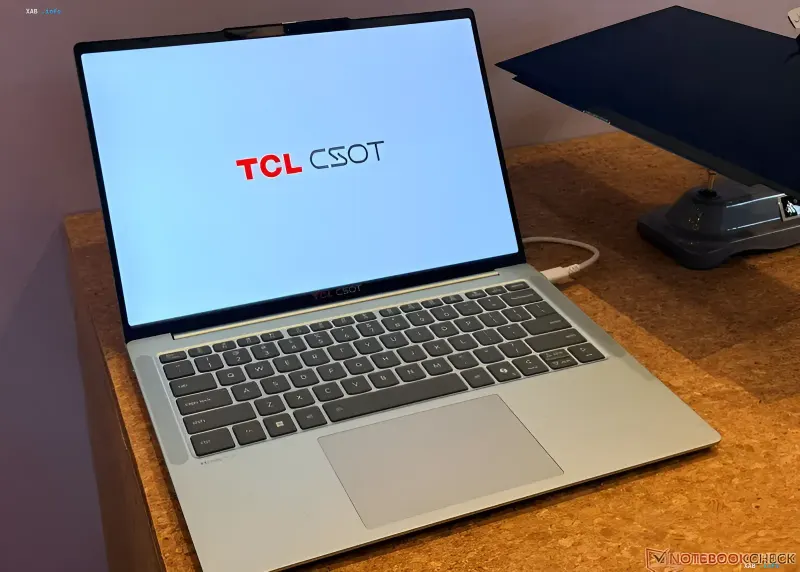
At the DTC 2026 industry exhibition, TCL CSOT presented a 14-inch liquid crystal display for laptops, which the manufacturer claims consumes less than one watt of power. The panel was mounted in a device resembling a Lenovo Yoga Pro laptop and demonstrated in operational state. Despite the extremely low power consumption, the display supports an adaptive refresh rate of up to 120 Hz, making it competitive in the premium mobile device segment.
“Milliwatt-class” and market comparison
TCL CSOT representatives classify the new panel as a “milliwatt-class” solution: the total power consumption of the entire liquid crystal module (LCM) is less than 1 W. For context: typical 14-inch IPS screens for laptops consume between 3 and 4.5 W, while models with higher resolution and high refresh rates often consume over 8 W. Thus, the stated figure is several times lower than the market average. According to the company's engineers, such low consumption was achieved through a design with a high light transmission coefficient, which improves backlight efficiency and reduces the load on the light source.
Resolution, brightness, and refresh rate
The prototype display features a resolution of 1920 × 1200 pixels and supports an adaptive refresh rate of up to 120 Hz. TCL CSOT did not publish official data on peak brightness at the booth; however, a company representative told NotebookCheck that the figure is in the 300 to 400 cd/m² range. This is a typical level for corporate and office laptops, although it might be considered modest for flagship models with HDR support.
Weight and ultra-thin design
Another announced feature of the display is its weight: the entire display module weighs about 100 grams. For comparison, standard 14-inch IPS panels usually range from 250 to 350 grams. The demonstrated prototype uses an ultra-thin panel design, oriented toward laptops with reduced chassis thickness. Reducing the screen weight directly impacts the overall device weight and ergonomics for mobile use cases.
Autonomy and rollout prospects
Reducing the display's power consumption could theoretically extend the battery life of laptops, as the screen is one of the largest power consumers in a mobile PC. However, TCL CSOT has not yet provided complete data on the system's total power consumption or results comparing battery life. It also remains unknown whether the Lenovo Yoga Pro chassis used in the demo is a prototype for a future commercial model or was used solely for the sake of the panel demonstration.
Mass production timelines
TCL CSOT has not announced exact dates for the start of mass production for this display. Industry rumors suggest a potential market release in 2027, but the company has neither confirmed nor denied these timelines. Thus, it will likely take at least a year before the first commercial laptops with such a panel arrive, during which TCL CSOT must finalize validation, receive approval from OEM partners, and establish mass production.