The latest BIOS firmware for MSI motherboards using Intel Z690 and Z790 chipsets features native support for the Bartlett Lake series—desktop chips that Intel originally positioned exclusively for embedded and industrial systems. This was first reported by user FL410, who identified processor ID D0670 and the corresponding microcode necessary for Bartlett Lake chips in current MSI BIOS files. Notably, MSI does not mention these changes in official release notes, and the support was added without any public announcement. According to FL410, the changes affect all MSI Z690 and Z790 series motherboards, though full compatibility across the entire device range has not yet been tested.
Independent verification: Core 9 273PE engineering sample runs on standard firmware
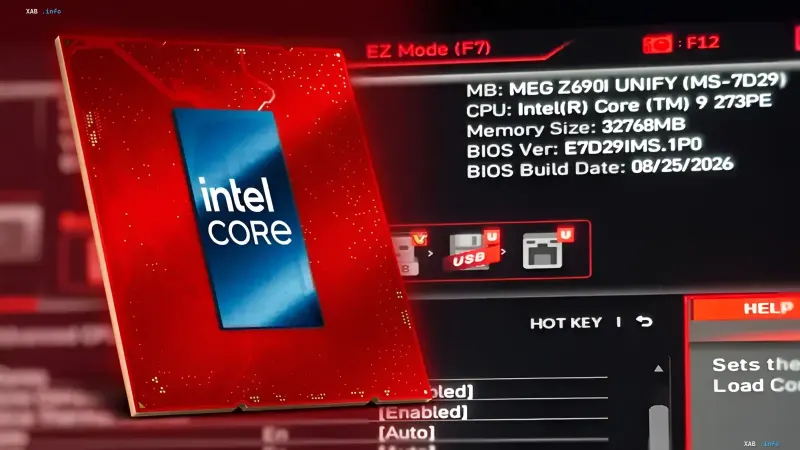
Information about native support was confirmed by social network X user LovK2X, who managed to successfully boot an engineering sample of the Intel Core 9 273PE processor (label Q9KU) on an MSI motherboard using a standard, unmodified BIOS version. According to the report, the processor boots and functions correctly under standard conditions. Lifting power consumption limits—parameters PL1, PL2, and ICCMax—is also possible. The only significant restriction remaining concerns RAM frequency: DRAM adjustment remains locked, although memory timing optimization is available. The BIOS screenshot published online shows an MEG Z690I UNIFY (MS-7D29) board with firmware version E7D29IMS.1P0 dated August 25, 2026, where the Core 9 273PE processor is recognized without any modifications.
From modified firmware to native support: a timeline of changes
Just a few days before the native support was discovered, the UNIKO's Hardware resource published test results of Core 9 273PE (12 P-cores) and Core 7 253PE (10 P-cores) processors on an MSI Z790 MPOWER motherboard. In that case, a modified firmware was required to run the chips: standard BIOS could not recognize Bartlett Lake processors. However, even in the modified configuration, it was possible to remove power limits and change the BCLK system bus frequency to 102.5 MHz, although System Agent voltage parameters and memory multipliers remained inaccessible for modification. Thus, the transition from "patched" modified firmware to native support in standard MSI BIOS became a logical and expected step for enthusiasts who have been experimenting with these chips for several months.
Context: why Bartlett Lake is "non-consumer" and what it changes
Previously, attempts to run Bartlett Lake processors on consumer motherboards were reported. In April 2026, an enthusiast managed to boot the Windows operating system on an Asus Z790 motherboard with a Core 9 273PQE processor using BIOS modifications developed with the help of artificial intelligence. Judging by recent data, such modifications are no longer required for some MSI motherboards, which significantly simplifies the task for the end user. It is important to understand that Intel originally introduced the Bartlett Lake series, consisting exclusively of high-performance P-cores without energy-efficient E-cores, for embedded and industrial systems, not for regular desktop computers. Formally, these chips are not intended for the retail market, and neither Intel nor MSI have officially announced their support on consumer boards. Nevertheless, the presence of native microcode in MSI BIOS indicates that the company has, at the very least, technically prepared the infrastructure to handle these processors.
What this means for enthusiasts and the market as a whole
The discovery of native Bartlett Lake support in MSI BIOS opens a new level of accessibility for enthusiasts to processors that are not formally sold at retail. Users who own engineering samples or have gained access to chips through specialized channels can now run them on standard consumer boards without needing to resort to modified firmware. This lowers the entry barrier and the risk of damaging the board by flashing a "patched" BIOS version. At the same time, MSI is not yet officially confirming support, and Intel is not revising the positioning of Bartlett Lake as an embedded line. Thus, the situation remains in a gray area: technically, the chips work; legally and from a marketing perspective, they do not. For the general public, this remains a niche interest, but the precedent of native support in the BIOS of major vendors could signal a shift in Intel's strategy for desktop platforms in future generations.