Researchers at the Medical College of Wisconsin have concluded that spaceflights may have delayed health consequences that do not appear immediately after exposure to the space environment, but manifest themselves long afterward. This is reported by RBC-Ukraine, citing work published in the professional journal PLOS. Since it is currently impossible to create a full-fledged laboratory outside Earth's protective magnetic field, scientists used special NASA ground protocols to simulate key spaceflight factors — weightlessness and radiation exposure — under controlled conditions.
How Space Conditions Were Simulated
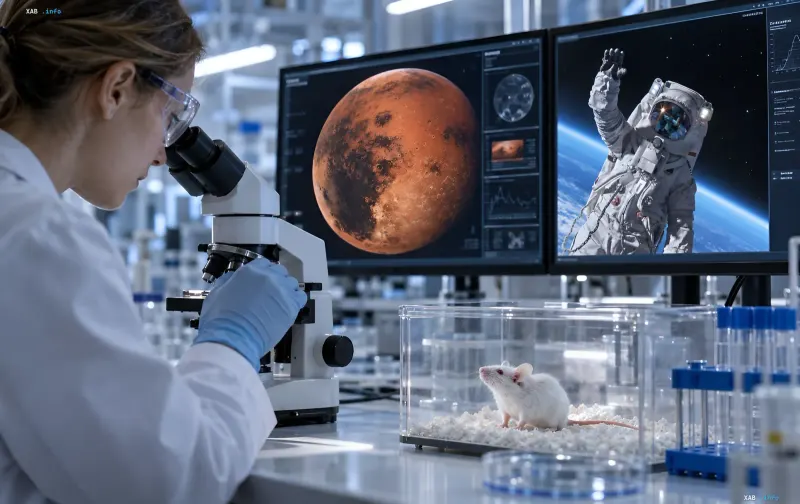
Middle-aged rats, corresponding to the age category of experienced astronauts, were used for the experiment. Weightlessness was simulated by hindlimb unloading: the animals' hind legs were elevated at a 30-degree angle for 30 days, causing fluid shifts toward the head and removing load from the lower body. Space radiation simulation was conducted at the NASA Space Radiation Laboratory at Brookhaven National Laboratory using the simGCRsim facility, which utilizes heavy silicon and iron ions combined with high-speed protons. Following intense irradiation and a month in the suspended state, the animals were monitored for a year, which is equivalent to approximately 25 human years.
Cardiovascular Consequences: Scars and Heart Attack Risk
The observation results turned out discouraging for planning future crewed missions to Mars. Scientists recorded that a radiation dose of 1.5 grays caused the development of perivascular fibrosis — the proliferation of connective tissue surrounding coronary vessels and compressing them, significantly increasing the risk of a heart attack. Even at lower doses expected during a three-year Mars mission, scar tissue changes developed in 83 percent of the studied animals a year after irradiation. At the same time, the symptoms themselves appeared not immediately, but after a long time, making them especially dangerous for astronauts, since by the time of detection the pathology may already be irreversible.
Blow to the Immune System: Loss of NK Cells and Blocked Recovery
Cosmic radiation combined with weightlessness dealt a heavy blow to the experimental animals' immune system. In the rats' spleens, the number of NK cells — so-called natural killers that destroy viruses and tumor cells — decreased by two-thirds. Crucially, while immunity subsequently recovered after weightlessness alone, the addition of radiation permanently suppressed the bone marrow's ability to respond to physiological stress. This means that an astronaut returning from Mars may end up with a chronically suppressed immune system, incapable of adequately fighting infections and oncological processes.
Genetic Mutations and 'Accelerated Biological Clock'
Genetic analysis of white blood cells conducted 235 days after irradiation revealed persistent mutations associated with clonal hematopoiesis of indeterminate potential (CHIP). On Earth, this process typically accompanies natural aging, when mutated blood cells begin to crowd out healthy ones. Radiation-induced CHIP quadruples the risk of heart attacks and strokes due to inflammation of artery walls, and also increases the likelihood of developing leukemia. Scientists emphasize that radiation effectively 'accelerated the ticking of the cardiovascular system's biological clock,' shifting it into a state characteristic of a significantly older organism.
Study Limitations and Prospects
The authors of the study honestly point out the existing limitations of the experiment: the animals received radiation in a single dose rather than gradually over several years as would happen in a real flight, and only male subjects participated. Nevertheless, the data obtained form a serious evidentiary base for revising medical protocols for astronaut preparation and developing protective strategies for long interplanetary missions. The results emphasize that the main threat of spaceflight is not acute radiation sickness, but delayed, 'silent' pathological processes that may manifest only years after returning to Earth.