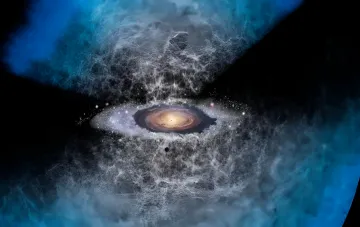
One of the central mysteries of modern cosmology is the nature of dark energy, which, according to generally accepted views, is responsible for the accelerated expansion of the Universe. However, new data, in particular results from observations by the DESI spectrograph, lead scientists to think that this component may not have been constant: its properties may have evolved along with the development of the cosmos. Based on these observations, an international team of researchers from Istanbul Technical University led by Professor Özgür Akarsu has proposed a theoretical explanation for this evolution. The work has been published on the arXiv preprint server, as reported by RBC-Ukraine.
What alarmed cosmologists in the DESI data
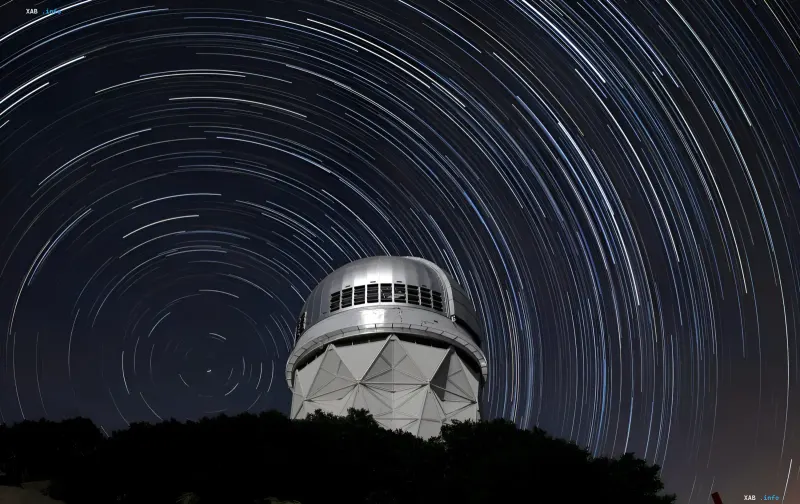
The Dark Energy Spectroscopic Instrument (DESI) is mapping millions of galaxies in 3D and capturing subtle signs that dark energy is not a strictly constant value as assumed in the standard model. It is these deviations from the "frozen" constant that became the starting point for the new work: the researchers tried to find a theoretical framework in which the change in dark energy density arises not as an artificial assumption, but as a natural consequence of the equations.
Teleparallel gravity instead of space curvature
To explain the observations, the team turned to an alternative theory known as teleparallel gravity. Unlike Einstein's general theory of relativity, where gravity is described through the curvature of spacetime, this theory represents gravity through the rotation, or "torsion," of space. Previously, one of the mathematical variants of this theory was dismissed because it implied a negative dark energy density. The researchers consciously removed this restriction and calculated a scenario in which the corresponding parameter could vary over time.
How dark energy density supposedly changed according to calculations
The calculations showed that in the first billion years after the Big Bang, dark energy possessed a negative density. Approximately 9.5 billion years ago, this indicator crossed the zero mark and has been positive ever since. The authors emphasize that such a transition arises naturally from the mathematical structure of the equations themselves, without the need to introduce additional artificial variables, making the model attractive from the standpoint of theoretical economy.
"Hubble tension" and testing on 47 million objects
In addition to describing the evolution of dark energy, the proposed approach, according to the researchers, helps resolve the so-called "Hubble tension" problem — the discrepancy between theoretical calculations and actual measurements of the Universe's expansion rate. Now scientists are preparing to test the model on the full DESI dataset, covering more than 47 million cosmic objects. If the hypothesis is confirmed, it will radically change humanity's understanding of fundamental laws of physics and how the Universe developed from the early epoch to the present day.