Scientists who analyzed data from nearly 3,000 Type Ia supernovae have concluded that dark energy — the force driving the accelerated expansion of the Universe — may not be constant but could change over time. This is reported by RBC-Ukraine, citing a study published on the arXiv preprint server. The result potentially revises one of the foundational assumptions of modern cosmology and raises new questions about the nature of cosmic expansion itself.
How supernovae became “standard candles”
Type Ia supernovae occur in binary star systems: when one of the stars dies and collapses into a white dwarf, it pulls matter from its companion star. Once the white dwarf's mass exceeds the so-called Chandrasekhar limit, a powerful thermonuclear explosion ensues. The key property of such events is their nearly identical luminosity, which allows astronomers to use them as a reference — a “standard candle” — for measuring cosmic distances and the redshift of light. It is precisely these measurements that underpin the picture of the Universe's accelerated expansion and, in essence, the very existence of dark energy.
Reinterpreting three decades of observations
The researchers combined about 30 years of telescope observations into a single framework, accounting for a range of systematic effects: the influence of cosmic dust, the mass of galaxies, and the gravitational lensing effect. This comprehensive approach made it possible to reduce errors and obtain a more accurate estimate of the evolution of expansion. According to the authors, it was precisely the combination of supernova data with the cosmic microwave background and maps of galaxy distribution that revealed a deviation from the traditional view of dark energy as constant.
Deviation from constancy
Based on the analysis, independent measurements from two different sources — supernova explosions and relic sound waves from the early Universe — indicate that the influence of dark energy is weakening over time. This means that dark energy may not be a strict cosmological constant but rather a dynamic quantity that evolves along with the expansion of the cosmos. The authors emphasize that the study is not yet complete: it will be supplemented by new observations from astrophysicists under the DEBASS (Dark Energy Bedrock All-Sky Supernova) program.
Contradictory data
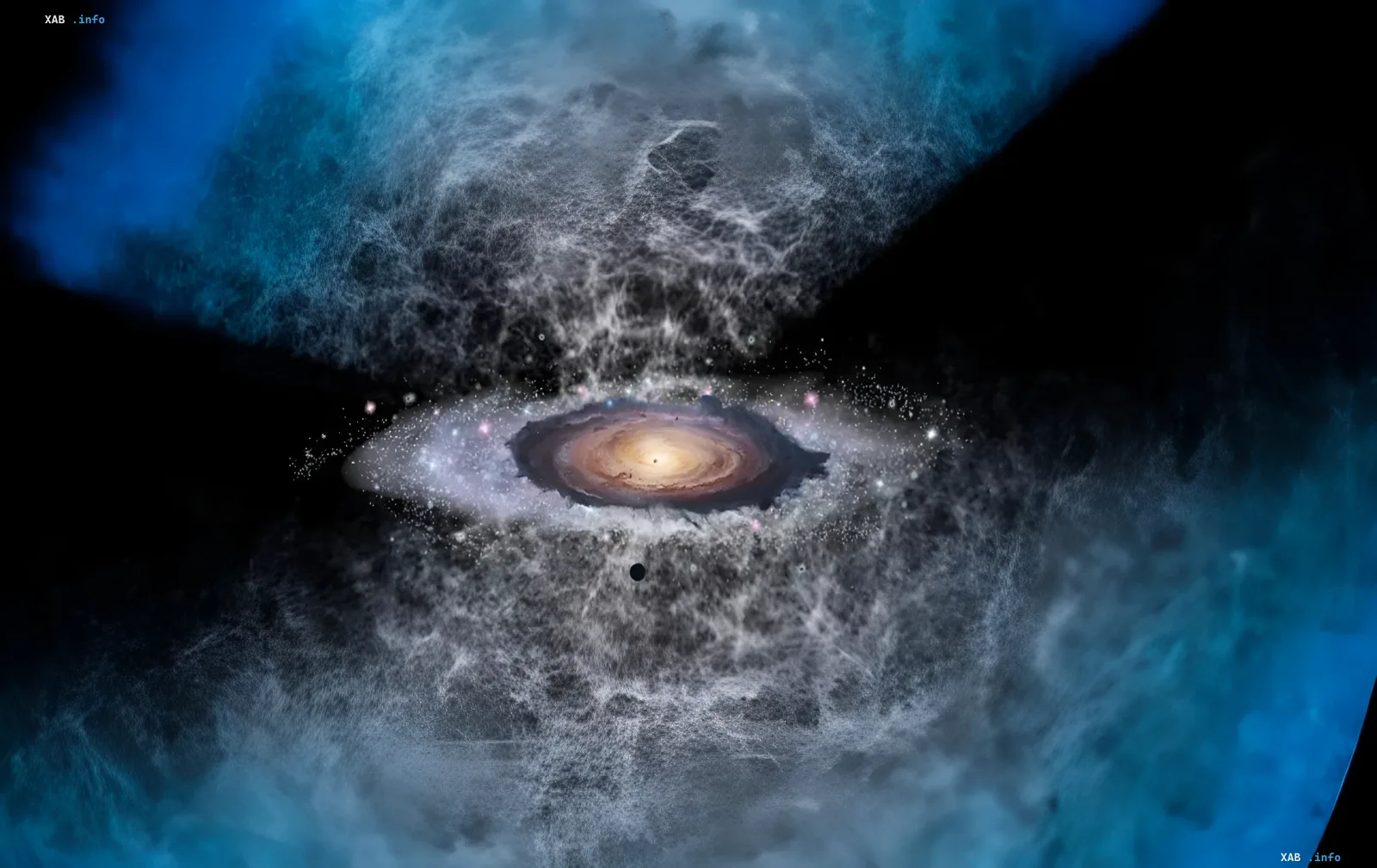
The scientific and public discourse around dark energy features differing emphases that should be presented openly. On the one hand, the classical ΛCDM model and most previous observations interpret dark energy as a constant quantity (the cosmological constant), and this interpretation remains the dominant one in cosmology to this day. On the other hand, the new arXiv study points to its evolution, while some publications propose alternative scenarios: for example, the possibility that dark energy may “feed on” dark matter and influence the shape of galaxy halos is discussed, as are scenarios in which the expansion of the Universe in the distant future could give way to a “Big Crunch.” Thus, there is no single definitive answer: these are competing interpretations of the same observations, and the final word will belong to the new data from the DEBASS program and the full peer-review cycle.
Significance for fundamental physics
If the evolution of dark energy is confirmed, it will not only help refine our understanding of dark energy itself but also provide an important clue for unifying Albert Einstein's general theory of relativity with quantum mechanics — a task that remains one of the central challenges in modern theoretical physics. At this stage, the conclusions are preliminary: the work has been published on a preprint server and is awaiting both independent peer review and confirmation by new observations, so the results should be regarded as a strong but not yet definitive signal.