An international team of scientists, following nearly thirty years of research, has for the first time discovered a microblazar in the Milky Way galaxy—a scaled-down copy of the core of ultra-bright distant galaxies. The system IRAS 18293−0941, registered back in 1983, has been confirmed as this unique object. This discovery is expected to become a major milestone in modern astrophysics for unraveling the mystery of the origin of cosmic rays.
Anatomy of a Unique Space System
The discovery was confirmed by an international team led by researchers from the University of Jaén in Spain using the European VLBI Network (EVN), a network of the most sensitive radio telescopes in the world. This cosmic system consists of a black hole with a mass of tens of solar masses and a massive companion star, whose material is actively devoured by the compact object. An accretion disk forms around the black hole, and powerful magnetic fields set two oppositely directed jets in motion.Jet Direction and Matter Velocity
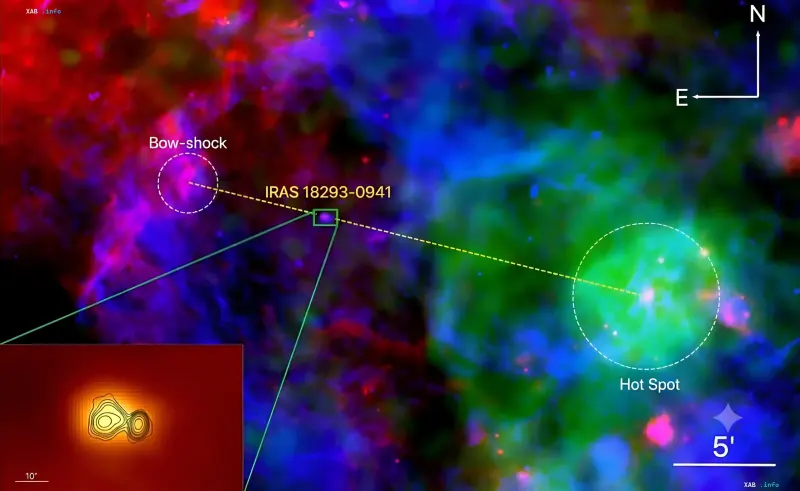
During detailed research, it turned out that one of these jets is directed almost precisely toward Earth, and the matter within it moves at a speed of about 0.75 the speed of light. The distance to the remarkable system is 12,000 light-years. Scientists note that discovering such a close and pronounced natural laboratory for studying cosmic radiation is of colossal scientific significance for global astrophysics.Massive Consequences and Giant Bubbles in the Interstellar Medium
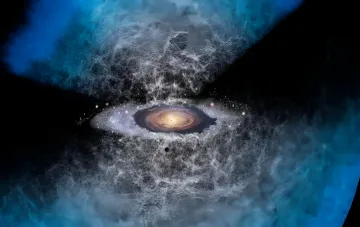
Additional optical observations showed that the system's components orbit each other in approximately 11.38 days. Using South Africa's MeerKAT radio telescope, it was established that the second jet formed a giant bubble 100 light-years long in the interstellar gas. Its edge, colliding with a dense gas-and-dust cloud, creates a unique region capable of accelerating charged particles to energies millions of times exceeding the capabilities of human-made ground accelerators.
Prospects for Further Scientific Research
Astrophysicists now have a rare opportunity to observe three crucial processes within a single system: the launch of a jet by a black hole, the giant cavity formed in the environment, and the collision point where particles accumulate colossal energy. Researchers plan to study this jet and interaction zone in detail in the near future to finally understand the mechanisms of energy transfer to the interstellar gas.