Modern astrophysical research challenges classical concepts regarding the origin of our world. According to a new hypothesis, our Universe may have been born inside a black hole within another, much larger cosmos. This assumption could radically alter our understanding of cosmology and offer an alternative to the standard Big Bang model, opening new horizons for theoretical physics in October 2026.
Galaxy Rotation Anomaly
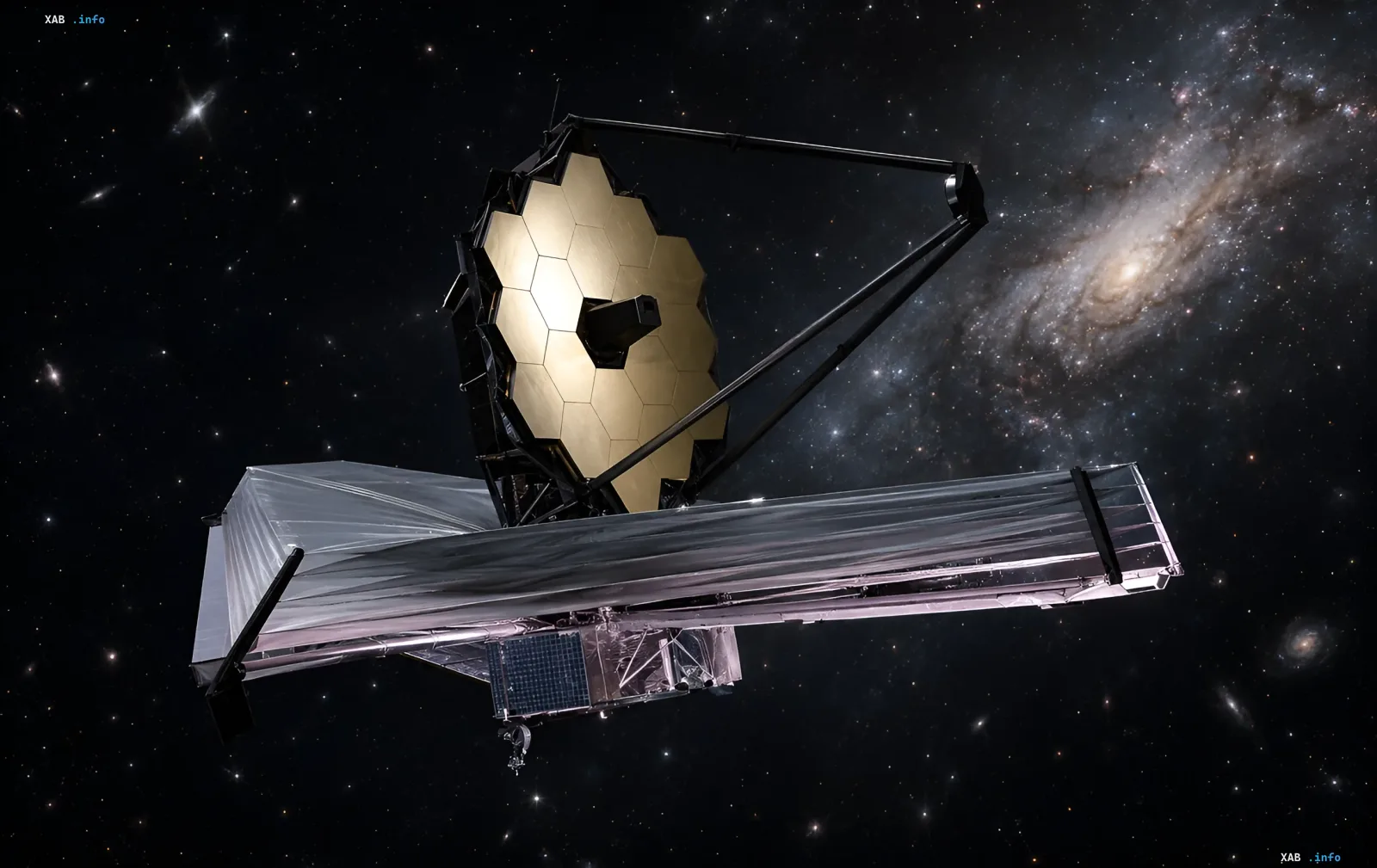
Scientists operated on the assumption that in a completely chaotic Universe formation, approximately half of all galaxies should rotate clockwise, while the other half should rotate in the opposite direction. However, a large-scale analysis of galaxy distribution and rotation performed using the JWST space telescope under the leadership of Kansas State University professor Lior Shamir revealed a clear and inexplicable asymmetry. Among the studied objects, only one-third of galaxies demonstrate clockwise rotation relative to Earth, while two-thirds rotate counter-clockwise.
Einstein-Cartan Theory and Black Holes
This discovered regularity confirms earlier observations, including a 2011 large-scale study by physicist Michael Longo. The presence of a single dominant direction of rotation indicates that our cosmos possessed its own axis of rotation from the very moment of its birth. The Einstein-Cartan gravity theory, which extends general relativity by accounting for spacetime rotation at the micro-level, helps explain this anomaly. Under the extreme conditions of the early Universe, such rotation could effectively counteract gravity, avoiding the infinite-density paradox.
Baby Universes and Wormholes
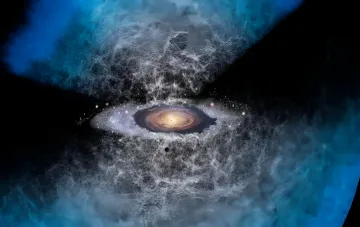
As physicist Nikodem Poplawski from the University of New Haven explains, within this framework, each black hole forms a closed baby universe inside itself. In such a scenario, the black hole itself acts as an Einstein-Rosen bridge or wormhole connecting the parent and child cosmoses. If the parent black hole possessed rotation, the newborn universe fully inherits its axis as the preferred direction of movement for its cosmic objects.
Contradictory Data
Despite convincing statistical data obtained from analyzing thousands of galaxies using the JWST telescope, the academic community remains divided on the conclusions of Lior Shamir and proponents of the Einstein-Cartan theory. Some astrophysicists insist that the observed rotation asymmetry may result from instrumental errors during sky scanning or local distribution peculiarities of visible matter in our galactic neighborhood. While the study's authors are confident in the reliability of their statistical sample, skeptics demand additional independent verifications using next-generation ground-based spectrographs.
Prospects and Autonomy of Our World
The theory also allows for the existence of countless baby universes already within our own cosmic space. Potentially, through supermassive black holes where tidal forces do not instantly destroy matter, one could theoretically penetrate such structures. However, returning back or transmitting any signal to the parent universe is physically impossible due to extreme gravity and the time-dilation effect, which turns the child world into a completely autonomous spacetime branch.