A group of theoretical physicists from Italy, France, and Denmark has published a study mathematically describing a scenario in which a black hole could theoretically split into two independent objects. The work, reported by RBC-Ukraine with reference to Universe Today, addresses one of the most fundamental problems of modern physics: the compatibility of thermodynamic constraints with the quantum-gravitational dynamics of compact objects. The authors—Francesco Sannino (University of Naples Federico II and the CP3-Origins Center at the University of Southern Denmark), Giacomo Cacciapaglia (Laboratory of Theoretical Physics and High Energy, LPTHE), and Manu Cennano (field theory)—have shown that under certain initial conditions, the decay is not only not prohibited but is thermodynamically permissible.
"Pair-of-pants topology": the geometry of decay
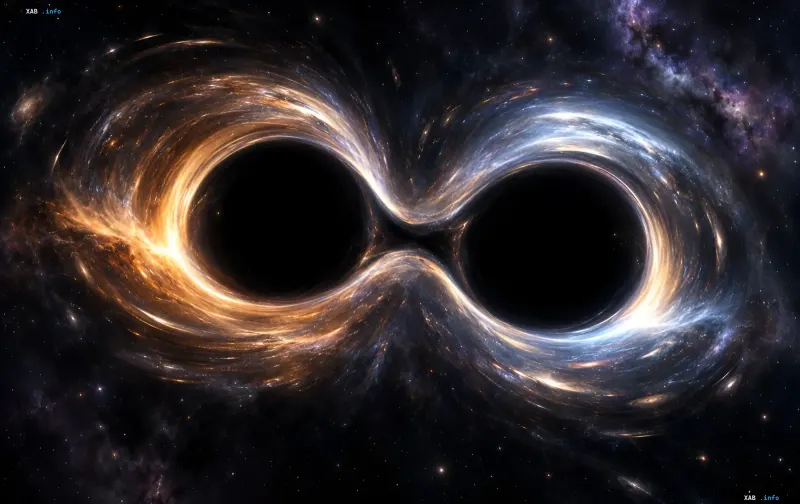
According to the mathematical calculations, at the moment of splitting, the event horizon of the original black hole takes on a shape resembling a pair of trousers: two "legs" correspond to the two new event horizons, and the crotch area represents the region where spacetime remains connected. This is why the researchers named this configuration a "pair-of-pants topology." This geometric structure is a key consequence of the fact that the decay process is not instantaneous but occurs through an intermediate state where the single singularity has not yet fully divided into two independent ones.
Rotation as the only "key" to decay
A critical condition without which the decay is impossible is the extremely rapid rotation of the original black hole. As Francesco Sannino explained, the initial black hole must rotate at nearly the maximum allowable speed—that is, be close to the Kerr limit, beyond which classical general relativity predicts the exposure of a naked singularity. Rotation alters the balance between the object's mass, angular momentum, and entropy: this shift is what allows it to overcome the thermodynamic barrier, which makes decay practically impossible for a stationary black hole. For a standard stationary black hole, splitting into two would lead to a decrease in the system's total entropy, violating the second law of thermodynamics. However, a rotating black hole possesses additional "freedom" in distributing angular momentum between two daughter objects, making the total entropy of the decay products no less than the entropy of the original body.
The "no-remerge" condition and the role of momentum
A second, equally important requirement derived by the authors is that the two newly formed black holes must fly apart in different directions immediately after splitting, with sufficient speed to prevent gravitational attraction from pulling them back into a single system. If conditions are ideal, the "twins" retain the initial momentum and velocity of the original object, causing their trajectories to diverge. Otherwise, calculations suggest that the two parts would quickly meet and re-merge, rendering the decay process reversible and, essentially, irrelevant in terms of observable physics.
Primordial black holes as the most likely candidates
The researchers emphasize that this is currently an exclusively theoretical concept; no such event has been recorded in the real cosmos. The precise probability of such a phenomenon cannot yet be calculated because it depends on how gravity operates in regimes beyond Einstein's general relativity—that is, on a yet-to-be-discovered theory of quantum gravity. Nevertheless, the authors point out that small primordial black holes, which may have originated in the first moments after the Big Bang, have orders of magnitude higher chances of decay than massive astrophysical objects, as their near-maximum rotation is achieved at significantly lower absolute values of angular momentum.
How to detect traces of decay
In the future, traces of such processes could be detected indirectly. Specifically, the researchers mention gamma-ray telescopes like Fermi-LAT, which are capable of detecting high-energy signals from tiny fragments formed during cosmic mergers and the splitting of compact objects. If a statistically significant anomaly in the gamma-ray spectrum is discovered in the data of such observatories—one that cannot be explained by standard models of accretion or mergers—it could become the first indirect evidence that black hole decay is not just a mathematical abstraction, but a real physical process occurring somewhere in the depths of the Universe.