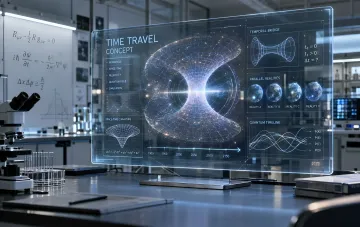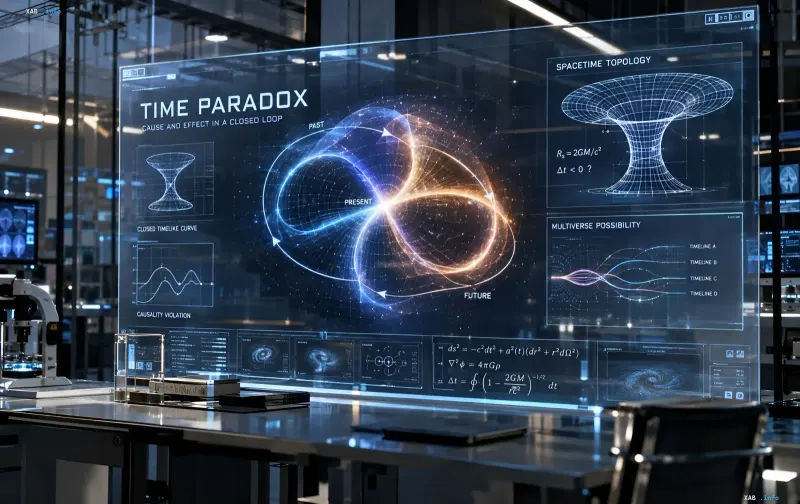
One of the most persistent paradoxes of theoretical physics — the so-called grandfather paradox — may receive a rigorous mathematical explanation. Physicists Mustafa Ismail and David Mattingly from the University of New Hampshire have published a paper in the journal Physical Review D, in which they propose an alternative model of gravity capable of making backward time travel fundamentally impossible. The study, which explains how to potentially resolve this, relies on metric-affine gravity theory and introduces a model called MAGIC (Metric-Affine Inflationary Cosmology with chronology protection). Under certain conditions, this model does not allow for the formation of closed timelike curves: time along any allowed trajectory moves only forward, which precludes returning to the past.
From the Grandfather Paradox to Hawking's Hypothesis
The essence of the grandfather paradox is simple yet devastating to the naive concept of time travel: if a traveler kills their own grandfather before their father is born, they never appear in the world and, therefore, cannot make the trip. In 1992, Stephen Hawking formulated the chronology protection conjecture, according to which the laws of physics do not allow the emergence of closed timelike curves — trajectories that allow one to return to the past. However, Einstein's general relativity does not mathematically exclude the existence of such paths, and for more than three decades, physicists lacked a clear mechanism explaining exactly what prevents their formation. The MAGIC model claims to fill this gap, shifting the prohibition to the level of the structure of gravitational interaction itself.
How the MAGIC model works
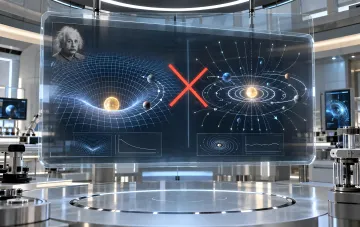
Unlike standard general relativity, where the spacetime metric and the affine connection (a mathematical object describing how vectors are carried between points) are rigidly linked, metric-affine gravity allows them to be described independently. Ismail and Mattingly used this freedom to build a model in which the geometry of spacetime and the "rules of parallel transport" evolve separately. As a result, in certain regimes, the model automatically imposes a ban on closed timelike curves: any worldline an observer might follow moves monotonically toward the future, and a "loop" closing the trajectory into the past becomes mathematically impermissible. Thus, chronology protection arises not as an external constraint, but as an intrinsic property of gravitational dynamics.
The weak point: scalar regime and instability
Despite the elegance of the approach, the MAGIC model carries a serious internal problem. In metric-affine theory, besides standard tensor gravitational waves, an additional type of oscillation appears — the scalar regime. According to the authors' calculations, these oscillations do not decay under certain conditions but rather grow exponentially. This means the model becomes dynamically unstable: small perturbations in the scalar field grow over time, making it impossible to use MAGIC as a stable description of the real universe. Furthermore, the guarantee of protection against time loops in the current formulation applies only to a limited region of space. To extend the principle to the entire cosmos, researchers will have to introduce additional assumptions about global topology or boundary conditions, which significantly complicates the theory.
A first step toward a holistic theory
The authors of the study honestly admit these limitations and do not claim that MAGIC is already the definitive theory of gravity. They position the work as a first step toward a more holistic model which, in the future, should explain why time travel to the past is impossible not by the "will" of some external law, but due to the internal structure of gravitational interaction. The publication in Physical Review D — a peer-reviewed journal among the most authoritative in physics — confirms that the approach is recognized by the scientific community as worthy of attention, even if its practical applicability remains in question. Further work, by the researchers' own assessment, will be aimed at suppressing the unstable scalar regime and expanding the scope of chronology protection to cosmological scales.