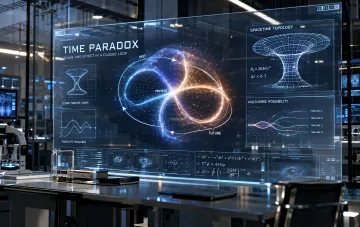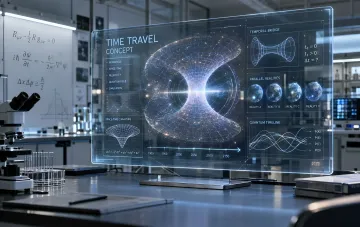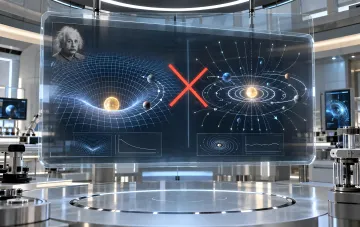
In the familiar macroscopic world, cause and effect look rock-solid: the cause happens first, followed by the effect. However, a new study published on the arXiv preprint server and reported by RBC-Ukraine indicates that at the level of quantum gravity, this order may not be so unambiguous: one event does not always strictly precede another. The authors applied the apparatus of quantum field theory to trace how microscopic fluctuations of spacetime affect the propagation of light, concluding that the very boundary between events capable of influencing each other and events where such a connection is impossible becomes blurred.
The Speed of Light Limit and Its Quantum Uncertainty
According to the special theory of relativity, nothing can move faster than light in a vacuum, and this exact limit determines which events can exert an influence on each other. A clear example: if the Sun were to suddenly go out, the Earth would "feel" it only about eight minutes later—that is how long it takes light to travel from the Sun to our planet. Similarly, a supernova explosion located a thousand light-years away could not affect Earth just a second after the explosion. In quantum physics, the picture is more complex: particles can exist in multiple possible states simultaneously, and their behavior is described through probabilities.
A Photon in a Spacetime "Superposition"
The first key conclusion of the researchers is that a photon—a particle of light—can travel through spacetime that is itself in several possible quantum states. From this, it follows that the exact arrival time of a signal cannot be predicted precisely; it is accompanied by a certain uncertainty. The second conclusion relates to hypothetical gravitons—particles that, according to physicists' expectations, should transmit gravitational interaction. If we simulate signal propagation in a medium with such quanta, the uncertainty will grow over time through a mechanism resembling a random walk, where small random deviations gradually accumulate.
The Longer the Path, the Blurrier the Causality Boundary
The combination of these effects leads to the main conclusion: the farther light travels, the harder it is to precisely determine the boundary separating events capable of influencing each other from those between which such a connection is impossible. At the same time, the authors emphasize an important nuance: this does not mean that information can travel faster than light or that the cause necessarily occurs after the effect. Under normal conditions, such quantum effects are extremely small and practically unnoticeable, but near objects with very strong gravity—primarily black holes—they can become more pronounced.
The Event Horizon as a "Blurred" Boundary
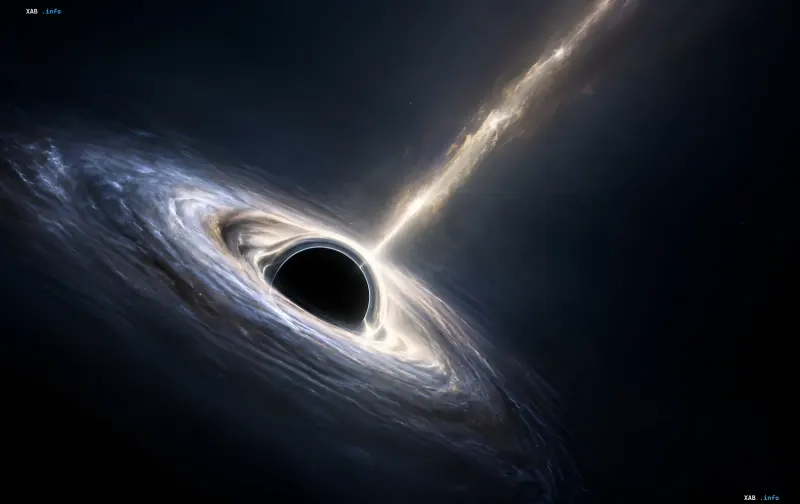
The researchers paid special attention to the event horizon—the boundary of a black hole beyond which nothing, not even light, can escape. It can be imagined as a surface formed by light rays held back by intense gravity. If the quantum uncertainty of this limit's position gradually increases, over time it could become comparable to the size of the event horizon itself. According to calculations, such a moment arrives roughly in the middle of a black hole's evaporation via Hawking radiation—it is precisely then that information about the absorbed matter should begin to gradually become recoverable, and the boundary between the inner and outer regions should significantly blur.
Hypothesis and the Path to Experimental Verification
It is important to emphasize that conclusions about black holes remain hypothetical for now: the corresponding calculations are speculative in nature and require further verification. The authors suggest that the main ideas of the study could eventually be tested by interferometers—devices capable of measuring extremely small changes in light travel time. Such experiments will help clarify whether quantum fluctuations of spacetime truly affect the propagation of light signals and how strongly they blur the familiar cause-and-effect structure of the Universe.