Scientists at Columbia University (USA) and the Adolfo Ibáñez University (Chile) have concluded that under certain conditions, gravitational fields are capable of "rupturing" and then reconnecting, thereby releasing a vast amount of energy. This was reported by RBC-Ukraine citing a work published in the specialized scientific journal Physical Review D. The discovery was made during a review of Albert Einstein's equations derived over a century ago, and represents one of the most notable theoretical results in general relativity in recent times.
Revising Einstein's equations: new variables, old laws
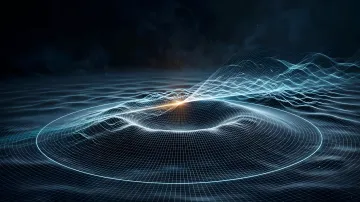
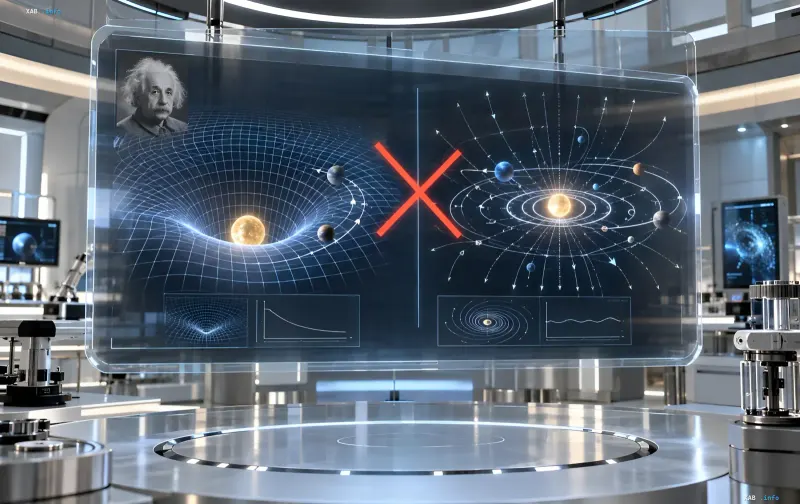
Albert Einstein described gravity not as a conventional force of attraction, but as a geometric distortion of spacetime generated by mass and energy. In recent years, physicists have been developing alternative mathematical formulations of these equations: essentially they remained the same, but were expressed through different variables. It was during this rewriting that researchers noticed the new form of Einstein's equations strikingly resembles equations describing the behavior of plasma—an ionized gas in which magnetic field lines can "rupture" and reconnect, releasing accumulated energy.
The "reconnection" mechanism in four-dimensional spacetime
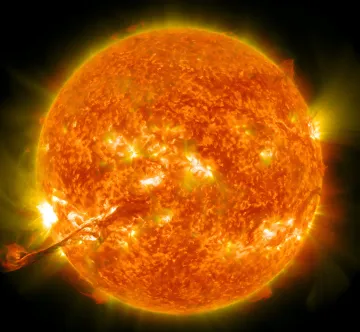
To clearly explain the proposed mechanism, the authors of the study suggest imagining four-dimensional "layers" of spacetime that can stretch, shift, rupture, and then combine in a new configuration. Similarly to how magnetic field lines in the solar corona open and reconnect, producing powerful flares, gravitational "layers" in the proposed model are capable of transferring energy to matter during large-scale cosmic events. According to the researchers' mathematical model, a significant release of energy occurs precisely at the moment of such reconnection.
From theory to astrophysics: black holes and gravitational waves
The authors emphasize that at the current stage, this is purely a theoretical discovery: there is as yet no experimental confirmation of the mechanism. The next step for the researchers will be to test how the described mechanism works in specific astrophysical scenarios—primarily during black hole mergers, when their colossal gravity radically distorts the local geometry of spacetime. Successful verification of the model will allow for more accurate calculations of the energy released in such events, as well as predicting the characteristics of the resulting gravitational waves, which is directly related to the tasks of modern gravitational-wave astronomy.
Significance for modern physics
If the proposed model is confirmed in the framework of further theoretical and observational studies, it will open up additional channels of energy transfer in strong gravitational fields that were not accounted for in standard numerical simulations of compact object mergers. This could correct the interpretation of data obtained by LIGO, Virgo, and future next-generation observatories, as well as enrich our understanding of spacetime dynamics in extreme conditions inaccessible to laboratory testing.