A team of physicists led by Gerald Gabrielse has unveiled a device that allows researchers to study individual antimatter particles with unprecedented precision. The results of the work are published in the scientific journal APS Physical Review Letters. The new device, dubbed the 'single-positron quantum cyclotron,' paves the way for a direct comparison of the properties of matter and antimatter at the level of fundamental particles—and potentially to an answer to one of cosmology's longest-standing questions: why the Universe did not vanish in a flash of mutual destruction after the Big Bang.
A Mystery the Standard Model Cannot Explain
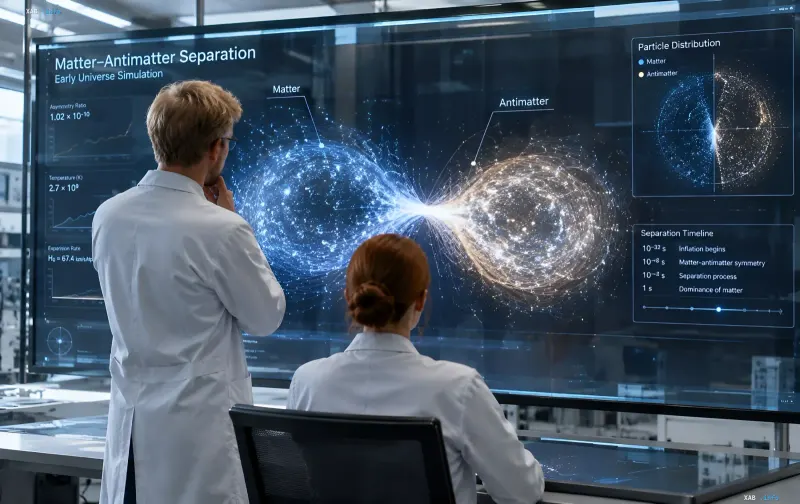
According to the Big Bang theory, roughly equal amounts of matter and antimatter should have been formed at the dawn of the Universe. Upon collision, these particles mutually annihilate, converting into energy. However, the observable Universe consists predominantly of matter: stars, planets, and everything around us are formed from it. Why such an imbalance arose remains an unresolved problem. As research leader Gerald Gabrielse notes, the Standard Model of physics provides no answer to this question, which is why scientists are turning to the simplest fundamental particles to identify potential gaps in the theory.
Why Antimatter Cannot Be Stored in a Conventional Container
The main technical challenge of working with antimatter is that upon contact with ordinary matter, it is instantly destroyed. That is why the team developed a special system that makes it possible to hold a single particle without physical contact with any surfaces. A positron—the antimatter counterpart of the electron—was chosen as the study object. The scientists created a setup in which a single positron is held in a trap and subjected to detailed analysis without the risk of annihilation.
How the 'Single-Positron Quantum Cyclotron' Works
Using precisely tuned microwave signals, the researchers have learned to control the positron's energy and observe as it transitions from one quantum level to another. This opens the path to extremely precise measurement of the particle's magnetic moment—a characteristic describing how it behaves in a magnetic field. Previous experiments by the same team have already allowed the measurement of the electron's magnetic moment with a precision of one part in 10 trillion. Now the task is to conduct a similar measurement for the positron with comparable precision.
What Happens If Theory Proves Wrong
According to current theory, the magnetic moments of the electron and positron should be equal in magnitude but opposite in direction. If the new measurement detects even the slightest difference between them, it will serve as direct evidence that modern physics is overlooking some important factor. Such a discovery could force scientists to reconsider the fundamental laws underlying 21st-century physics and perhaps provide a key to understanding why matter 'won' over antimatter in the early Universe.