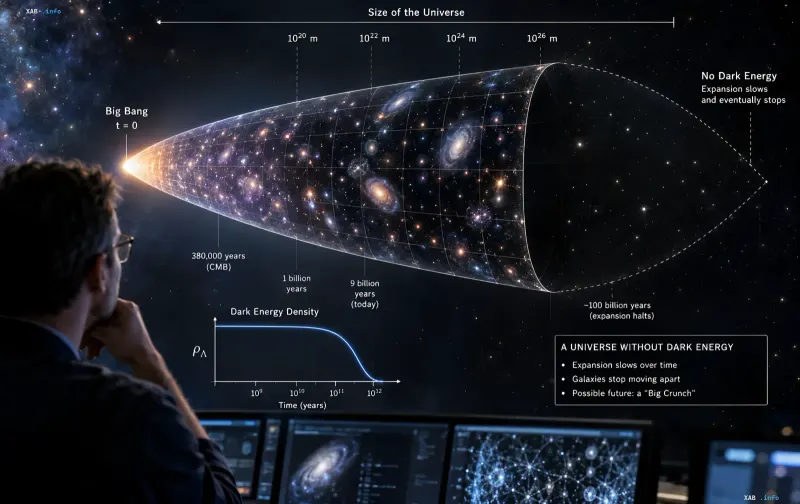
For decades, one of the most persistent puzzles in modern cosmology has remained unresolved: the calculated strength of dark energy, derived from quantum field theories, exceeds what astronomers actually observe in the universe by roughly a factor of a billion. This discrepancy is considered one of the biggest inconsistencies in theoretical physics. To resolve this contradiction, a group of physicists has proposed an unexpected model, published on the arXiv preprint server and described by RBC-Ukraine.
From Compactified Dimensions to an "Unrolled" Micron Scale
In standard formulations of string theory, extra spatial dimensions are typically imagined as tightly curled up and virtually invisible to an observer. The authors of the new model, built upon a weakly coupled version of string theory, proposed a different scenario: one of the extra dimensions could be significantly larger than commonly assumed—on the order of one micron. On the scale of the subatomic world, even a micron, comparable to the size of a bacterium, is considered a huge distance, so such a dimension would occupy an intermediate niche between the world of the smallest particles and cosmic scales.
Why the Micron Becomes a Key Scale
If the hidden dimension truly exists, its traces should manifest in the unusual behavior of gravity at very small distances—roughly starting from one micron. It is precisely this scale that separates familiar Newtonian gravity from potentially new physics, and it is at this scale that the hypothesis becomes sensitive to measurements. Thus, the model links a macroscopic cosmological problem—the nature of dark energy—with a specific, measurable submicron range.
The Hypothesis Can Be Tested in the Laboratory
An important difference between the proposed scheme and many purely mathematical constructs lies in its testability: the prediction can be verified not only through calculations, but also via laboratory experiments measuring deviations in gravitational interaction at distances on the order of a micron. If such experiments confirm the forecast, it will become a weighty argument in favor of string theory. Even in the event of a negative result, the search for the hidden dimension narrows the space of possible models and helps to better understand the laws governing the universe.
What This Means for Physics as a Whole
The proposed model does not claim to be a proven fact: it is a working hypothesis posted in a preprint version and awaiting experimental verification. Nevertheless, it demonstrates how revisiting standard assumptions about the compactification of extra dimensions can simultaneously affect both quantum gravity and cosmology. For the scientific community, this is yet another example of how the mystery of dark energy continues to stimulate the search for new scales and new ways to detect them.