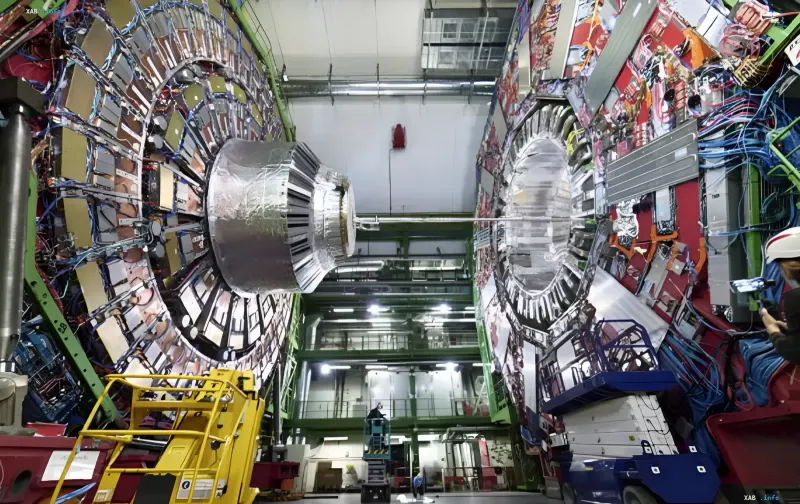
Physicists working with data from the Large Hadron Collider (LHC) have applied advanced machine learning algorithms to search for traces of microscopic black holes. The study, announced by the press service of the University of California, Santa Barbara, opens a new chapter in modern high-energy experimental physics. The primary goal of the scientists was to discover points of intersection between gravity and quantum mechanics—two fundamental pillars of modern science that have yet to be unified into a single theory.
The Role of Artificial Intelligence in Data Analysis
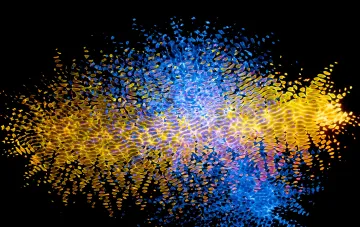
To search for elusive micro black holes, scientists used a fundamentally new artificial intelligence algorithm for the first time. Unlike traditional methods, the AI analyzed the entire picture of proton collisions as a single entity, simultaneously correlating the energy and movement vectors of all resulting particles. This comprehensive approach significantly improved the accuracy of filtering data collected during experiments from 2016 to 2018.
Despite the high efficiency of the new machine learning algorithm, researchers did not record any signs of microscopic black holes forming. This null result is of colossal importance for fundamental science. In particular, it places strict limitations on popular theoretical models, including string theory, which postulates the existence of ten spatial dimensions. The new data shows that if additional dimensions do exist, their number within the studied parameters cannot exceed two.
Controversial Data
It is worth noting that discussions continue within the scientific community regarding the interpretation of large-scale energy experiments and the accuracy of applied mathematical models. Some independent researchers point out that existing collision energy limits at the LHC leave a loophole for alternative hypotheses about hidden dimensions. Nevertheless, the official position of the research group from the University of California is based on a rigorous analysis of empirical data and rules out the possibility of multidimensional structures in the available energy range without a colossal increase in accelerator power.
The Search for Sphalerons and Modernization Prospects
In addition to searching for black holes, physicists have also actively searched for unstable particle states known as sphalerons. Their discovery could shed light on the fundamental mystery of the universe's origin—why baryon asymmetry allowed matter to prevail over antimatter after the Big Bang. Although sphalerons have not yet been detected, the very process of ruling out false theories narrows the field for further searches.
Currently, the Large Hadron Collider has been temporarily shut down for a large-scale upgrade. It is expected that after the completion of technical work and detector updates, the instruments will allow for the recording of even subtler physical effects, bringing humanity closer to unraveling the birth of the Universe.