The European Organization for Nuclear Research (CERN) and the French company Mistral AI have announced a long-term partnership aimed at creating foundational artificial intelligence models to support scientific discoveries. Joint work has kicked off in high-energy physics — one of the most resource-intensive disciplines in modern science requiring the processing of massive datasets.
Large Physics Model Named Flare
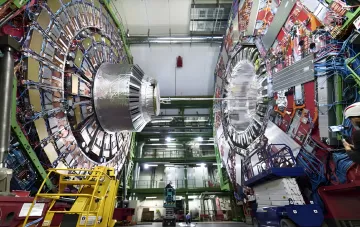
The central project of the collaboration will be a pretrained foundational model named Flare (Large Physics Model). According to plans, it will be trained on billions of simulated proton-proton collisions recorded at the Large Hadron Collider (LHC), the world's most powerful particle accelerator.
A Single System Instead of an Algorithm Chain
Today, signals captured by LHC detectors must be sequentially converted into reconstructed particles and physical objects before specialists begin their measurements. This process is structured as a chain of specialized algorithms where machine learning is already applied at individual stages. The Flare foundational model is designed to work differently: learning from the entire data reconstruction process and functioning as a single system capable of solving multiple tasks simultaneously — reconstructing collision parameters, identifying particles, flagging unusual signals, and helping evaluate future detector designs.
Why High-Energy Physics
Enrica Porcari, head of CERN's IT sector, noted that high-energy physics provides a unique environment where artificial intelligence can be developed and verified with exceptional rigor. CERN emphasizes that the partnership will combine its own expertise in particle physics, scientific data processing, and large-scale computing with Mistral's experience in training large models.
Prospects Beyond CERN
The organization expects that the insights gained from creating Flare will eventually prove useful not only for CERN's internal tasks but also for the broader scientific community. Thus, the partnership with Mistral AI lays the foundation for a whole class of tools that can accelerate the search for new physical phenomena and lower the cost of experimental data analysis.