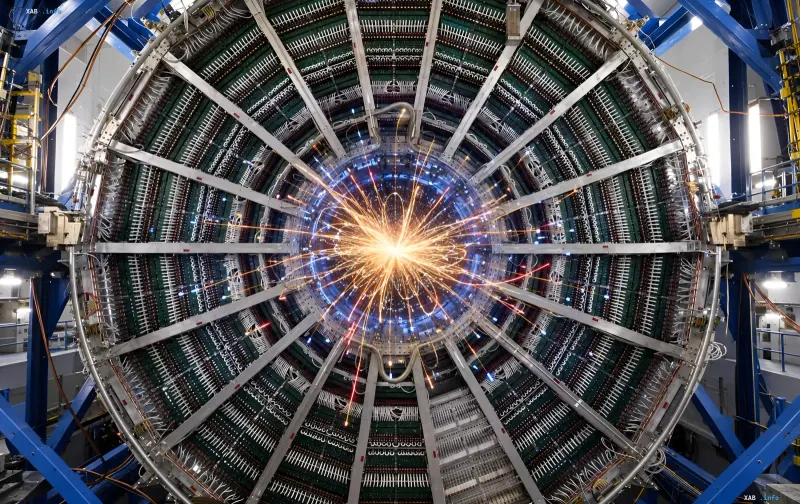
At the Large Hadron Collider in the European Organization for Nuclear Research (CERN), located on the Swiss-French border, physicists have conducted an experiment that, by their own estimates, brings science closer to unraveling the fundamental laws of nature. During high-energy atom collisions, researchers studied decay products and recorded an unstable subatomic particle—the so-called "beauty" quark. According to the participants, the results of the experiment could form the basis of a new theory explaining the deep mechanisms of the universe.
A Particle Living for 1.5 Trillionths of a Second
The beauty quark is one of the six known quark flavors included in the Standard Model of particle physics. From the perspective of experimental physics, its distinctive feature is its extremely short lifetime: the particle exists for just 1.5 trillionths of a second before decaying into lighter particles. Physicists jokingly call this scale the "zeptoverse"—it is 100 billion times smaller than a standard atom. It is at such scales, researchers believe, that particles may exhibit heightened sensitivity to dark matter, making the detection of their interactions a unique opportunity to study this mysterious substance, which has hitherto revealed itself solely through gravitational effects.
Dark Matter Just One Collision Away
Dr. Harry Cliff, data analysis lead, emphasized that researchers are literally coming closer to understanding the behavior of new particles and strive to maintain the pace of their work. According to him, the recorded interactions provide scientists with an unprecedented tool for testing hypotheses about the nature of dark matter—a component of the universe that, according to modern estimates, accounts for about 27% of all mass-energy in the cosmos, yet does not interact with electromagnetic radiation and is therefore invisible to telescopes of any type.
A £150 Million Upgrade
To continue and deepen the research, the 28 member states of the CERN project have agreed on a £150 million upgrade of the detector. According to the scientists' calculations, the equipment renewal will increase the registration rate of such decays tenfold, opening access to statistically significant event samples needed to test alternative models beyond the Standard Model.
The British U-Turn and Scientific Community Criticism
Despite the experiment's success, UK Research and Innovation (UKRI) announced its withdrawal from funding the planned detector upgrade. The decision caused sharp criticism in the scientific community. Professor Tim Gershon noted that such steps put the UK at risk of losing leadership in future fundamental discoveries and deprive the country of the opportunity to train new generations of specialists in high-energy physics. Against the background of budget constraints, he said, many young researchers are already considering continuing their careers abroad, where funding prospects are more stable.
UKRI Remains CERN's Second-Largest Donor
UKRI, in turn, emphasizes that the UK remains a full participant in CERN and the laboratory's second-largest donor, with an annual budget of about £175 million. Thus, abandoning the funding of this specific upgrade stage does not mean a complete withdrawal from the project, but critics argue that this particular upgrade is key for the next decade of research at the LHC.