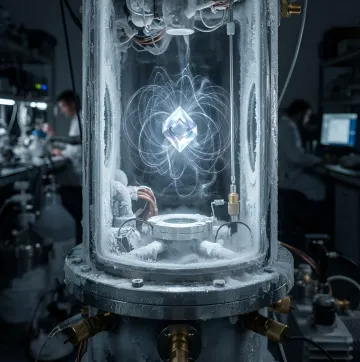
Modern cosmology has long operated on the alarming hypothesis that our Universe might exist in a state known as a false vacuum. According to this theory, our reality resembles a ball stuck in a hollow on the slope of a steep hill, while the absolute bottom holds a lower, more stable true vacuum state. Transitioning to that bottom point via quantum mechanical tunneling could theoretically spawn a destructive bubble erasing all matter at the speed of light.
The Quantum Controller and Stability Mechanism
Researchers from Syracuse University in the USA and the University of Portsmouth in the UK published a study in the Journal of Cosmology and Astroparticle Physics explaining how the Universe avoided this catastrophe. The Higgs boson—the fundamental particle that grants mass to all matter—played a pivotal role in protecting the cosmos. Scientists analyzed the behavior of quantum fields during the early inflationary expansion and identified a powerful stabilizing factor.Decoherence as a Cosmic Safeguard
A crucial part of system stabilization is decoherence, driven by continuous interaction between quantum fields and their environment. Microparticles lose their quantum oddities and begin acting like deterministic physical objects. The researchers describe this as continuous 'observation' by the environment, making it extremely difficult for the system to alter its state or execute a dangerous quantum leap across the barrier.