Cosmic void, familiar to us as absolute zero energy, may turn out to be merely a temporary state. According to New Scientist, cited by RBC-Ukraine, a group of physicists is considering a scenario where the space of the Universe could transition to a state with an even lower energy level. Such a transition, termed "vacuum decay" in scientific discourse, would theoretically lead to a complete restructuring of the laws of physics and the destruction of all existence. While the hypothesis is not a sensation for a narrow circle of specialists, its public discussion once again raises the question of how stable the reality we live in actually is.
False Vacuum: The Metaphor of an Egg in a Bowl
To provide a clear explanation, physicists resort to a simple analogy. Imagine an egg resting at the bottom of a deep bowl. From an observer's perspective, it is in stable equilibrium: to move, it needs to overcome the bowl's rim. However, the floor is actually lower, and energetically that position is even more favorable. In quantum physics terminology, the current state of the Universe is compared to a "false vacuum": it looks stable, but theoretically could transition to a "true vacuum"—a state with the lowest possible energy density. The key word here is "theoretically," since the transition requires overcoming the energy barrier separating the two states.
Quantum Tunneling and the Bubble of a New Vacuum
The mechanism that allows a system to "leak" through the barrier without an additional energy influx is quantum tunneling. Within this phenomenon, a particle ends up on the other side of a potential barrier without possessing the classical kinetic energy required to do so. Applied to the vacuum, this means that at some point in space, a tiny bubble of a new vacuum could spontaneously form—a region where fundamental constants, properties of matter, and even the geometry of spacetime differ from what we are used to. The future fate of this bubble is determined by its internal parameters: surface tension and the energy difference between the two phases.
What Happens If the Bubble Starts to Grow
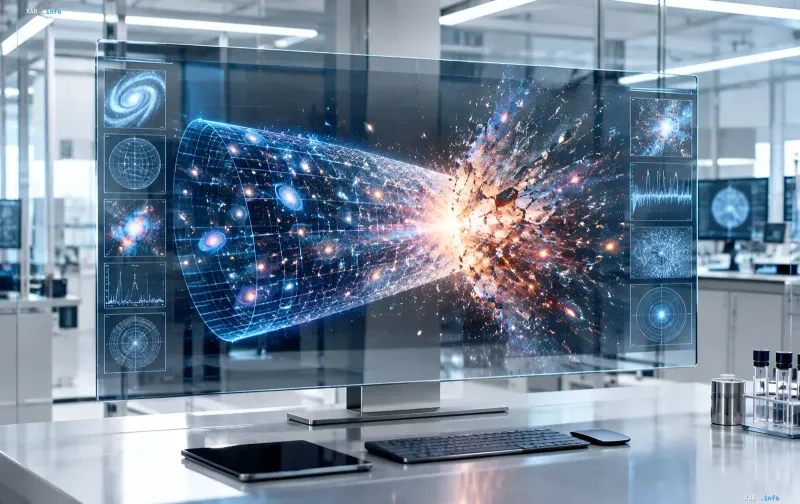
Computer simulations conducted by researchers show two fundamentally different outcomes. If surface tension dominates and the energy gain is small, the bubble instantly collapses and disappears without any observable consequences. In the opposite case—when the energy reserve is sufficient—the micro-bubble begins to expand at the speed of light, absorbing matter and destroying all quantum fields in its path. According to modeling results, inside such a formation, reality completely collapses: familiar spacetime structures cease to exist. A crucial feature of the scenario is that the destruction front moves at the speed of light, so no signal about the approaching catastrophe will reach an observer before the event itself. Destruction, by this logic, would be absolutely instantaneous and unpredictable for anyone inside the Universe.
How Physicists Attempt to Assess the Stability of the Universe
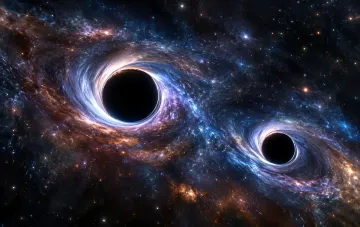
Direct laboratory testing of the vacuum decay hypothesis is impossible: the scale of phenomena and energy barriers vastly exceed the capabilities of any existing or planned experiment. Therefore, physicists work with indirect methods. The central object of attention is the mass of the Higgs boson—a particle associated with the symmetry-breaking mechanism and the generation of elementary particle masses. Precise measurements of this mass, as well as other parameters of the Standard Model, allow calculations of whether our vacuum is in a stable, metastable, or unstable state. Based on current data, the Universe may be in a metastable regime, but measurement uncertainties do not yet allow for a definitive conclusion. In parallel, another avenue is being explored: searching for traces of tiny new vacuum bubbles that, according to one hypothesis, could form during black hole collisions and fall inside them before they have time to expand. In the future, scientists hope to discover indirect evidence of such a process through characteristic radiation associated with the evaporation of primordial black holes.
Is It Worth Panicking
Despite the dramatic nature of the described scenario, physicists discussing this hypothesis are unanimous on one point: ordinary people have no cause for alarm. Even if vacuum decay is theoretically possible, it represents a process that humanity cannot influence either technically or organizationally. The probability of a spontaneous transition on a human timescale is estimated to be vanishingly small, and the process itself, by definition, cannot be predicted or prevented. Thus, the false vacuum hypothesis remains a subject of fundamental physics—important for understanding the limits of applicability of our theories, but nothing more.