Scientists at the University of Ottawa have presented a cosmological model that radically revises two pillars of modern astrophysics: the age of the universe and the necessity for so-called dark components. According to the paper published in the peer-reviewed journal Monthly Notices of the Royal Astronomical Society (MNRAS), the age of the universe is 26.7 billion years — nearly twice as old as assumed in the standard ΛCDM model. Moreover, according to the authors' calculations, neither dark matter nor dark energy is required to describe observed phenomena. The study was conducted by physics professor Rajendra Gupta and Nikolaos Samaras.
The CCC+TL Model: How the Alternative Works
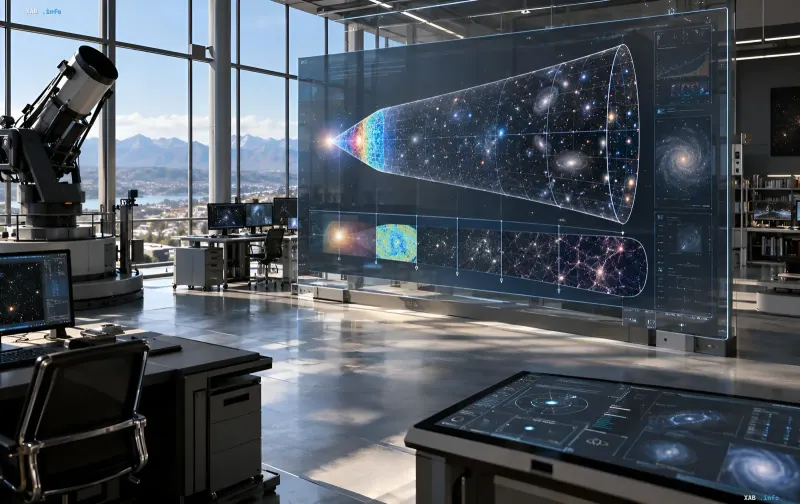
The new concept is called CCC+TL — covarying coupling constants plus tired light. Instead of introducing invisible substances that have eluded direct detection for decades, the model suggests that the fundamental constants governing the interaction of forces and particles change over time. Light, in turn, loses energy while traversing vast distances. These two mechanisms, in the authors' view, reproduce the effects that the standard model attributes to dark matter and dark energy. To test the theory, Gupta and Samaras modified Einstein's and Friedmann's equations, developing new mathematical tools.
Consistency with Observational Data
The authors claim the model demonstrates high consistency with key astronomical data. Predictions regarding the abundance of hydrogen, helium, and other light elements formed in the first minutes after the Big Bang matched the values predicted by the standard model. Data from cosmic chronometers confirmed the calculated expansion rate of the universe. The researchers paid particular attention to galaxy rotation curves: an analysis of the SPARC database, covering 175 galaxies, showed that the model can reproduce the observed curves without invoking dark matter. Furthermore, in the analysis of the Bullet Cluster collision, the additional gravitational effect in the new model follows the galaxies themselves rather than the hot X-ray gas, which the authors believe is an important argument in favor of the concept.
The Problem of Early Galaxies and the "Missing" Four Billion Years
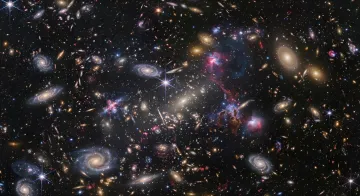
One of the most acute problems in modern astrophysics is the detection of extremely massive and mature galaxies in the early stages of cosmic history. In the standard model, the age of the universe at the cosmic dawn is estimated at approximately 300 million years, which is widely considered insufficient for the formation of such objects. According to the CCC+TL model, at the same redshift level, the universe's age is about 4.6 billion years. This additional time, the authors estimate, allowed galaxies to grow about 12 times larger in size and mass than the standard theory suggests, thereby resolving the conflict between theory and observations.
Verification: The GLIMPSE Program and the James Webb Telescope
The next stage of testing the theory will be the GLIMPSE program, in which the James Webb Space Telescope will purposefully search for galaxies with record-high redshifts. If such objects are discovered in the early universe, where the standard model would suggest there was not yet enough time for them to form, it will be a strong argument for the alternative model. The scientific community traditionally requires new cosmological theories to undergo independent verification on independent datasets before displacing the established paradigm.
Context: Why This Is Important
The standard ΛCDM model, in which about 27% of the universe's mass-energy is accounted for by dark matter and about 68% by dark energy, has dominated cosmology for the last two decades. Nevertheless, neither of these substances has been directly detected, and the discovery of massive early-galactic structures increasingly questions the sufficiency of ΛCDM. Gupta and Samaras's work is not the only attempt to revise the model: other alternatives, including hypotheses about modified gravity at different scales, are being discussed in scientific literature. However, the CCC+TL model stands out by offering a unified mathematical framework that simultaneously explains nucleosynthesis, cosmic expansion, galaxy rotation curves, and cluster dynamics without introducing additional invisible components.