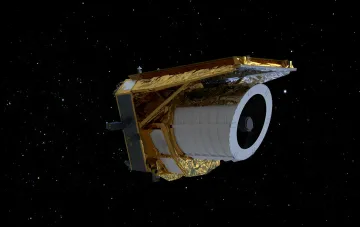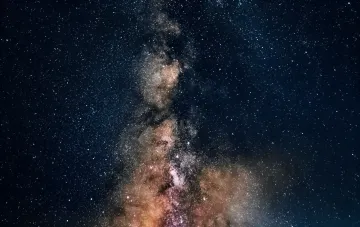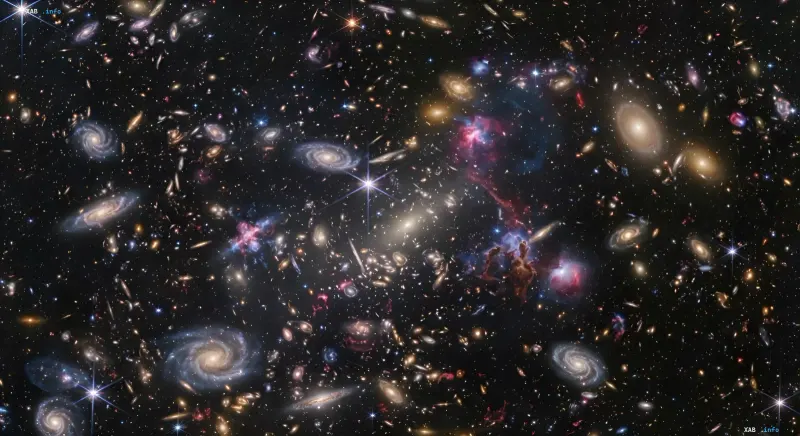
The European Space Agency (ESA) has published the first major catalog of observations from the Euclid space telescope. It contains data on more than 900 million galaxies, 60 million quasars, and about 15,000 candidates for strong gravitational lenses. The total volume of collected material is 1.7 petabytes—data accumulated over approximately 13 months of continuous observations, covering an area of the sky roughly 9,500 times the visible size of the Moon. According to ESA, this accounts for only about 14% of the planned survey, underscoring the scale of the upcoming work.
The most detailed 3D map of the Universe
The main goal of the Euclid mission is to create the largest 3D map of the Universe in history. To achieve this, the telescope does not just photograph galaxies but also measures distances to them, which allows for the reconstruction of the spatial structure of cosmic objects. ESA plans to cover more than one-third of the celestial sphere by 2031, helping scientists trace the history of the Universe over the last 10 billion years. The full catalog of the first survey is scheduled for publication in mid-2027.
Quasars from the early Universe
Among the objects in the new catalog are quasars, extremely bright galactic cores with active supermassive black holes. Some of these formed when the age of the Universe was only about 5% of its current age: light from these objects traveled to Earth for approximately 13 billion years. This makes them unique "windows" into an era when cosmic structures were just beginning to form, allowing scientists to study the conditions under which the first supermassive black holes were born.
Gravitational lenses as a tool for weighing dark matter
The new data contains about 15,000 candidates for strong gravitational lenses—an effect that occurs when the gravity of a massive object in the foreground bends the light of a more distant galaxy. According to Natalie Lines, a researcher at the University of Portsmouth, this effect allows scientists to "weigh" galaxies along with the invisible dark matter they contain, providing a direct path to quantitatively assessing its distribution in the cosmos.
Cosmic web and Euclid's technical capabilities
Scientists intend to use the catalog data to study the so-called cosmic web—a network of galaxies and their clusters separated by vast voids. The structure of this network and its evolution over time depend, in particular, on the properties of dark matter and dark energy, making Euclid one of the key tools for cosmology in the coming decade. The observatory was launched in July 2023 and is equipped with a wide-angle optical telescope with a 600-megapixel camera, as well as an infrared spectrometer and photometer, which allow for the detection of galaxies and the collection of data to determine distances to them.