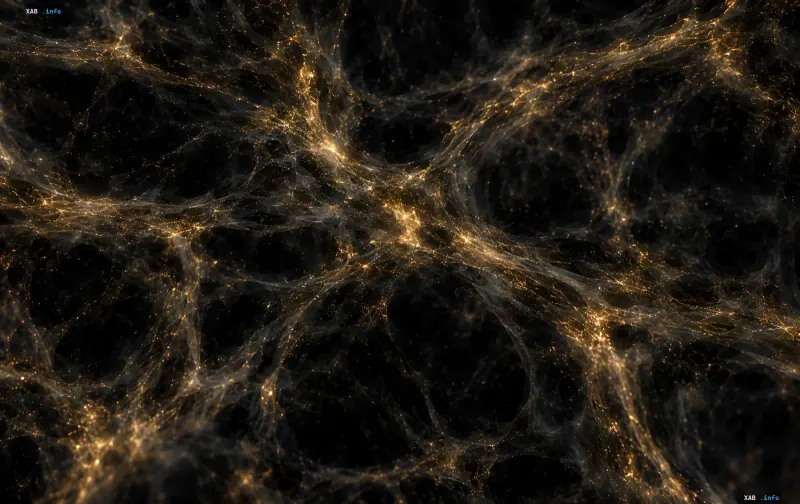
Dark matter — the invisible substance that, according to modern understanding, makes up about 85% of all matter in the universe and determines the dynamics of stars and galaxies — remains one of the greatest unsolved problems in modern physics. For decades, the leading candidates for dark matter were WIMPs (Weakly Interacting Massive Particles), hypothetical heavy particles that interact extremely weakly with ordinary matter. However, no collider experiment, including the Large Hadron Collider, has yet detected these particles. This lack of direct evidence is precisely what drove Dartmouth College physicists Guangmin Liang and Robert Caldwell to seek explanations beyond the Standard Model of particle physics, within the realm of condensed matter physics.
From a "Hot Soup" to Pairs: The Superconductivity Analogy
In a new study published in the peer-reviewed journal Physical Review Letters, the researchers propose a model in which, during the first seconds after the Big Bang, dark matter existed as a hot "soup" of fast, light, and massless particles. As the universe expanded and cooled, these elements, by analogy with electrons in superconductors, began to bind into pairs. The reference to superconductivity is no coincidence: under certain conditions, particularly at very low temperatures, electrons in a material form so-called Cooper pairs, which allow electrical current to flow without resistance. The authors suggested that a similar mechanism could have operated on dark matter particles in the early stages of the cosmos.
Why Stars in Galaxies Move Faster Than They "Should"
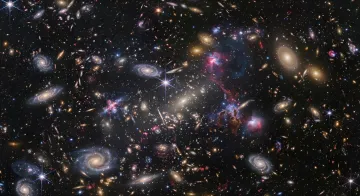
A key observation explaining the existence of dark matter is the anomalously high rotation speed of stars in the outer regions of galaxies. Calculations based solely on visible mass fail to explain these speeds: stars should fly apart were it not for the additional gravitational pull of the invisible substance. The proposed model of paired dark matter particles could offer a new explanation for this anomaly, as the properties of the formed pairs affect the distribution and dynamics of the gravitational field on galactic scales. This does not eliminate the need for further refinement of the model, but it opens an alternative path for interpreting observational data.
How to Test the Hypothesis: Traces in the Cosmic Microwave Background
It is important to emphasize that the proposed model is a theoretical assumption, not a confirmed fact. Nevertheless, the authors point to a specific experimental pathway for its verification: the features of the formed dark matter pairs may leave subtle traces in the cosmic microwave background (CMB) — the electromagnetic radiation left over from when the universe was about 380,000 years old. Current and future missions studying the CMB are capable of detecting such anomalies, which would either confirm or refute the hypothesis. The authors honestly acknowledge the high probability that their initial conclusions could be wrong, but emphasize that unorthodox approaches are precisely what often lead to breakthroughs in fundamental physics.
"All Available Tools Are Needed"
In the concluding part of the paper, Liang and Caldwell formulate a general principle that will likely become the motto of a generation of researchers: "Unraveling the mystery of dark matter requires using all available tools, from quantum physics to astrophysics." Transferring ideas from condensed matter physics to cosmology is not the first such step in science, but its success in this case remains an open question. If the model is confirmed, it will not only explain the nature of dark matter but also strengthen interdisciplinary ties between seemingly distant fields of physics. For now, the work remains a theoretical hypothesis awaiting testing against observational data.