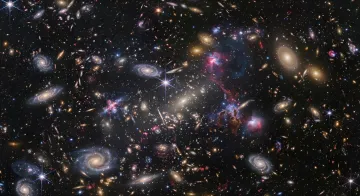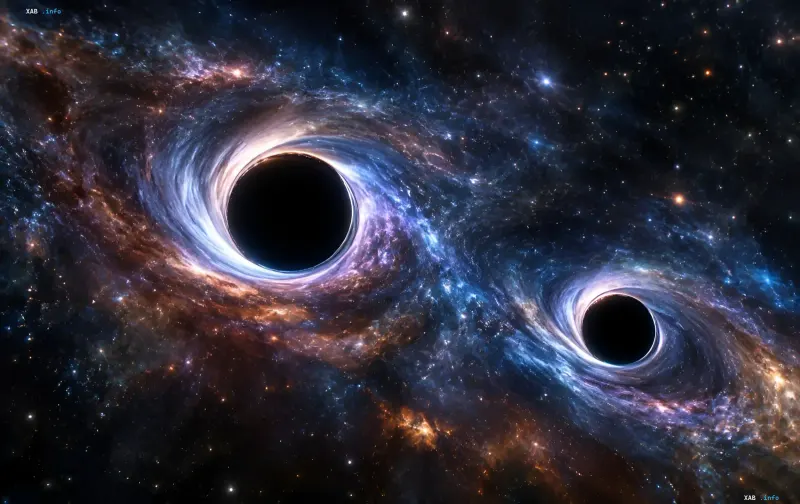
An international team of astronomers led by Silvia Onorato of NSF NOIRLab has announced the discovery of the oldest and most compact pair of quasars in observational history. The object, cataloged as J1602+4228AB and given the Hawaiian name Nāpōwawāʻenakaulua, exists in the era of the cosmic dawn — just 900 million years after the Big Bang. The research results were published in the peer-reviewed journal The Astrophysical Journal Letters in 2026. The discovery challenges established models of supermassive black hole formation and galaxy development in the first billion years of the universe's existence.
How two bodies were distinguished at a distance of 13 billion light-years
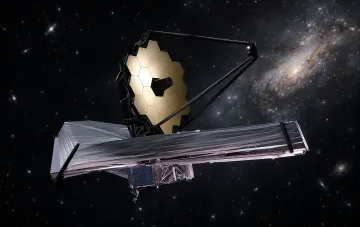
The initial detection of the pair was performed as part of the Aether program using the James Webb Space Telescope's (JWST) spectrograph, which surveyed more than 200 quasars. However, to confirm that these were indeed two separate objects rather than a single distorted source, the team switched to the ground-based Gemini North telescope located on the Mauna Kea volcano in Hawaii. Thanks to exceptionally favorable weather conditions and high atmospheric transparency, the scientists managed to complete verification in just two nights of observation — a timeframe considered record-breaking for such tasks.
Why the existence of this pair contradicts current models
According to the standard cosmological picture, in the first billion years after the Big Bang, active galaxies gradually formed the first supermassive black holes at their centers. The growth process was assumed to be long and gradual. The Nāpōwawāʻenakaulua pair, however, demonstrates scales impossible to explain within existing theoretical models: two supermassive black holes in close orbital proximity had already reached sizes by the 900-million-year mark of the universe that, according to calculations, would have required significantly more time. The researchers explicitly point out that, at present, there is no definitive theoretical explanation for how a single giant black hole could have gained such mass so early, let alone a pair of such objects in close proximity.
The 'dense region' hypothesis of the early universe
As a working explanation, the study's authors propose the hypothesis that Nāpōwawāʻenakaulua formed in a region of the early universe with an anomalously high density of baryonic matter. In such an environment, galaxy interactions could simultaneously accelerate the birth of new stars and the feeding of matter into black holes, creating conditions for super-fast growth. Nevertheless, this hypothesis remains speculative: it is not confirmed by direct observations and is not integrated into generally accepted galaxy formation simulations. This is why the pair of quasars represents a rare opportunity for astrophysicists to reconsider the notions of how galaxies were formed and how the early universe developed.
Context: a series of anomalous discoveries in the early universe
The detection of J1602+4228AB is not an isolated incident. In 2026, astronomers already reported a number of objects in the early universe whose parameters fall outside the scope of standard models — including unusually bright red sources with hidden black holes inside. The combination of such findings suggests that our understanding of the speed and mechanisms of supermassive black hole growth in the first few hundred million years after the Big Bang likely requires significant revision. Future observations by the JWST and next-generation ground-based telescopes, according to the researchers, will allow for the refinement of the pair's parameters and possibly the discovery of additional examples of such systems.