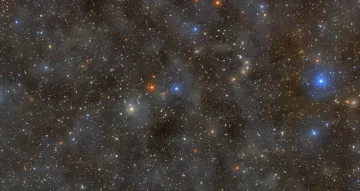
Astronomers have presented new evidence for the existence of an object that could become the first confirmed "starless" galaxy in history. It is the Cloud 9 system, located 14 million light-years from Earth in the vicinity of the spiral galaxy Messier 94 (M94). According to the study published on the arXiv preprint server, the object contains colossal reserves of hydrogen and dark matter, yet it emits no light — not a single stellar source has been detected within its boundaries. RBC-Ukraine reports this, citing the results of observations conducted using the HiPERCAM camera on the Gran Telescopio Canarias and data from the Hubble Space Telescope.
What Is Cloud 9 and Why Is the Object Called a "Ghost Galaxy"
According to astronomers' estimates, Cloud 9 contains a cloud of neutral hydrogen with a mass of about one million solar masses and a dark matter halo of roughly five million solar masses. For comparison: a typical dwarf galaxy contains anywhere from tens of millions to billions of solar masses of stellar material. Under normal conditions, such hydrogen reserves serve as the "building blocks" for star formation — it is from them that luminous bodies are born, which then illuminate the surrounding space. However, in the case of Cloud 9, Hubble observations revealed a complete absence of stellar radiation. Most objects in the Universe containing similar masses of gas and dark matter leave a noticeable light trail. Cloud 9, by contrast, is essentially "invisible" in the optical range, which gave rise to the metaphor of a "ghost galaxy."
Observation Methodology: 2.36 Hours of Integration with Not a Single Signal
To test the hypothesis of the object's starlessness, a team of scientists led by Ignacio Trujillo from the Instituto de Astrofísica de Canarias (IAC) used the HiPERCAM camera installed on the Gran Telescopio Canarias — the largest optical telescope in the world. The scientists managed to obtain the deepest images to date of a section of Cloud 9. Over 2.36 hours of continuous signal integration, no stellar radiation of any kind was detected. In parallel, data from the Hubble Space Telescope also revealed no signs of a stellar population within the object. The combination of these observations forms the most compelling argument to date in favor of the conclusion that Cloud 9 truly contains no stars.
Why the Stars Never Lit Up: The Role of Background Ultraviolet Radiation
Cosmologists explain the Cloud 9 phenomenon by the influence of background ultraviolet radiation permeating the Universe after the epoch of reionization. According to their model, in small dark matter halos the gas is unable to cool and collapse efficiently to form the first stars, because external UV radiation keeps it in an ionized or partially ionized state. Numerical simulations show that dark matter halos with a mass below five billion solar masses should remain starless for a significant portion of the Universe's history. Cloud 9, with a dark halo mass of about five million solar masses, falls within this range, which is consistent with theoretical predictions.
Contradictory Data
The sources covering the discovery show differences in how the object's status is formulated. In materials referencing the arXiv preprint, Cloud 9 is presented as the "first confirmed starless galaxy in history." However, the same study explicitly states that the object's final status must be established by further observations using the James Webb Space Telescope (JWST). Thus, at the time of publication, the matter is not one of unequivocal confirmation but of the strongest evidence available to date. In addition, a number of publications (in particular, ixbt.com) emphasize that Cloud 9 is the "first galaxy made of dark matter," highlighting the dominance of the dark component, while other sources (pravda.ru) point to the possibility of a "hidden error" in the interpretation of the data, which may indicate alternative explanations for the absence of glow — for example, insufficient sensitivity of the observations in certain ranges or the influence of the neighboring galaxy M94. The differing emphases do not negate the fact of the arXiv publication and the use of HiPERCAM and Hubble data, but they underscore that the discussion within the scientific community is not yet over.
What Comes Next: The Role of the James Webb Telescope
The key verification step will be observations using the James Webb infrared space telescope. JWST has significantly greater sensitivity in the infrared range, which will allow it either to detect faint stellar sources hidden behind dust clouds or to conclusively confirm the absence of a stellar population in Cloud 9. If JWST detects not a single stellar object within the halo, Cloud 9's status as the first confirmed starless galaxy will be cemented in the astronomical literature. The results of such observations, the authors expect, may be presented within the coming months. Until then, the object remains the most compelling candidate for the title of "ghost galaxy," and its study opens a new window into understanding under what conditions dark matter and gas can exist in the Universe without giving rise to a single luminous body.