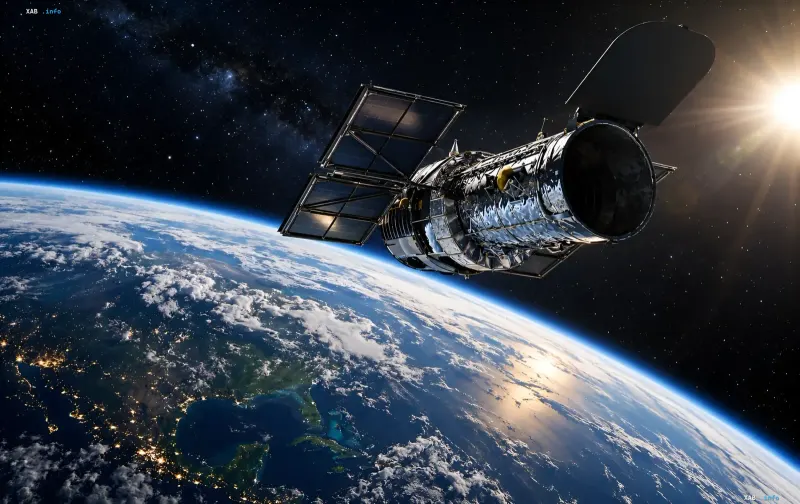
An international team of astronomers, relying on observations from the Hubble Space Telescope, has reached a conclusion that could revise one of the key models of early universe evolution. The research results have been published in the journal Nature Astronomy. The scientists showed that supernova explosions in the first galaxies likely did not clear a path for ultraviolet radiation, as had been assumed for decades, but instead created barriers of neutral gas and dust that trapped photons within the galaxies.
The Fog That Hid the Universe
For roughly the first billion years after the Big Bang, outer space was filled with a dense "fog" of neutral hydrogen. This gas efficiently absorbed ultraviolet radiation, making the universe opaque to that part of the spectrum. As the first stars and galaxies formed, their powerful radiation began splitting hydrogen atoms into protons and electrons—a process known as the Epoch of Reionization. It was this process that transformed the universe into a transparent medium, allowing light to travel across cosmological distances.
The Inverse Relationship Discovered by Hubble
For a long time, hydrodynamic models were dominated by the hypothesis that supernova explosions generated powerful galactic winds, blowing neutral gas out of the neighborhoods of young stars and opening channels for ultraviolet photons to escape. However, the research team analyzed the spectra of star-forming galaxies and found a different picture: galaxies with the fastest supernova-driven winds transmitted the smallest fraction of ultraviolet radiation. According to observational data, the energy of the explosions disrupted the surrounding environment and increased the coverage of light-trapping neutral gas and dust rather than destroying it.
Young Stars as the Main "Lanterns" of Reionization
These findings support an alternative theory in which the central role in reionization is played not by supernova activity, but by the radiation and weaker local winds of young stars during the early stages of galactic development. According to this new perspective, these processes allowed photons to leave galaxies even before powerful galactic winds from supernovae could form. Thus, the universe's first "lanterns" were ignited not during catastrophic explosions, but during a period of relatively calm existence for hot young stars.
Model Adjustments and Future Plans
Supernova explosions still hold a central place in modern hydrodynamic models describing the evolution of the universe. The new study means scientists will need to make significant adjustments to computer simulations to account for the impact of young star radiation by the time of the first supernova outbursts. The research team is already planning to secure additional observation time on the Hubble Telescope to analyze the spectra of other galaxies and test their conclusions on a broader sample of objects.