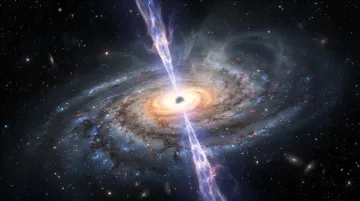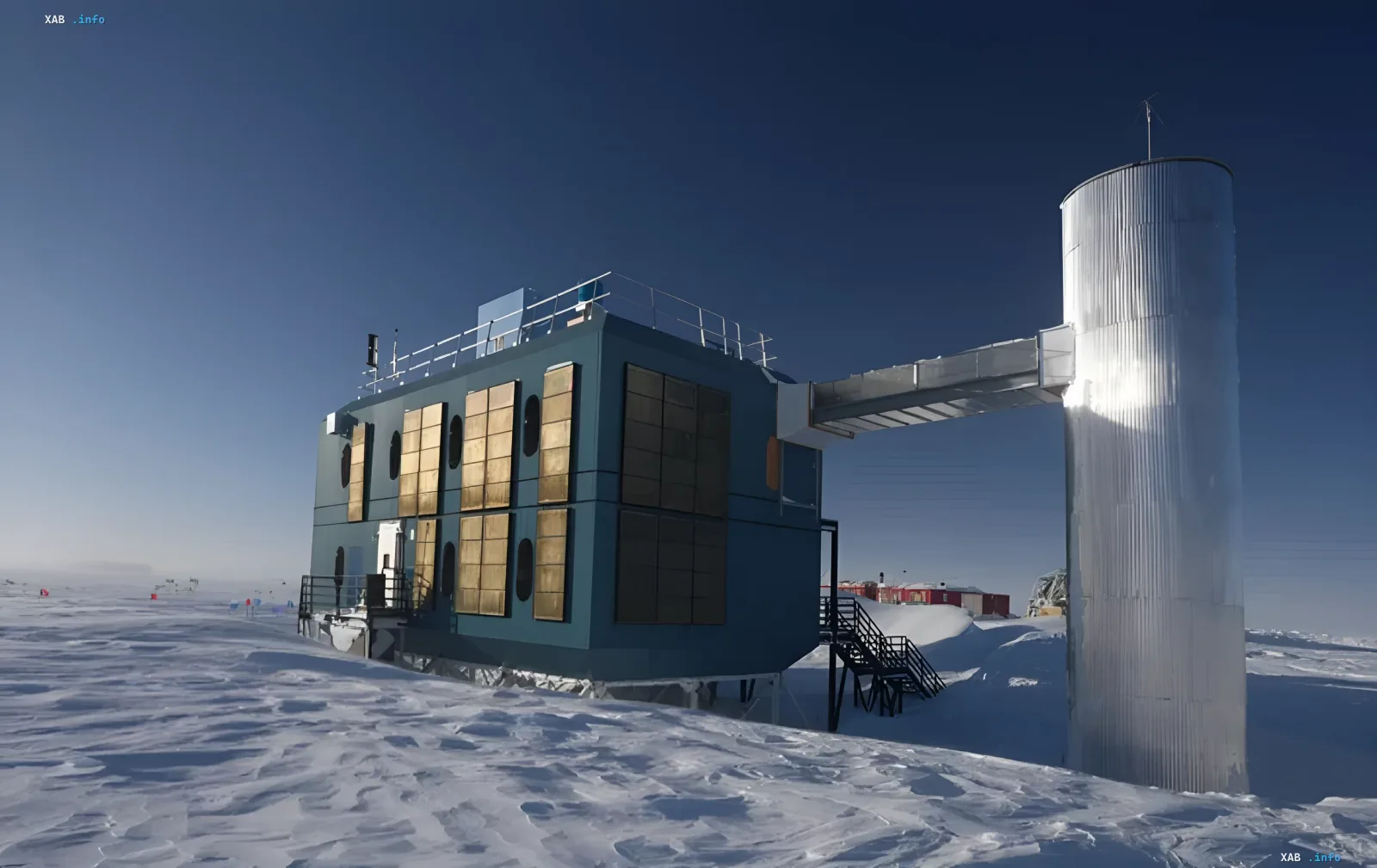
The IceCube Neutrino Observatory, installed beneath the ice of Antarctica, has undergone its first major upgrade since 2010. According to RBC-Ukraine, citing the official IceCube Neutrino Observatory, the modernization added hundreds of ultra-sensitive light sensors to the existing infrastructure, with the total cost of the work amounting to 53 million dollars. As envisioned by the scientists, the upgrade will significantly improve the accuracy of neutrino detection and enable detailed study of some of the most energetic processes in the Universe — supernova explosions, mergers of black holes and neutron stars, as well as the origin of ultra-high-energy cosmic rays.
How Ice Becomes a Giant Detector
Neutrinos are produced by nuclear reactions and particle decay throughout the Cosmos. These particles have virtually no mass, carry no electric charge, and interact extremely rarely with ordinary matter, making them impossible to "catch" directly. IceCube solves the problem differently: it records the rare outcomes of neutrino collisions with ice atoms, which produce flashes of light. Natural ice, however, contains dust and crystals that scatter and refract light rays, reducing measurement accuracy. To compensate for this effect, researchers installed hundreds of new sensors, 2–3 times more sensitive than the previous generation of equipment.
Ice Calibration and Reassessment of a Fifteen-Year Archive
In addition to the detectors, the upgrade deployed new calibration instruments. Their task is to more precisely measure the optical properties of the ice directly around the observatory. This is especially important because the ice medium is non-uniform and changes over time. Thanks to the new calibration, scientists will be able to reassess the archive of data accumulated over 15 years of observations, effectively "recalculating" part of the already collected measurements with improved environmental parameters.
What This Will Reveal to Astronomers
Tracking the direction and energy of neutrinos makes it possible to identify the sources of powerful cosmic explosions. In the case of black hole and neutron star mergers, combining neutrino data with gravitational waves will uncover the mechanisms of particle acceleration during such cataclysms. Galactic supernova explosions are of interest because neutrinos burst out of the core of a dying star almost instantaneously, whereas light is delayed in the gas and dust: detecting a neutrino burst will serve as an early warning for astronomers, allowing them to point optical telescopes at the object before the first visible light appears. Detecting neutrinos from gamma-ray bursts, in turn, will provide the first direct evidence that these explosions are indeed the source of ultra-high-energy cosmic rays.
Context of Parallel Research
It is worth noting that open sources are also discussing other results from IceCube's work in parallel — in particular, decades of dark matter searches and reports of radio waves that have traversed the thickness of ice and rock. These areas are not part of the described detector upgrade and do not contradict it: they reflect the observatory's broad research program, within which the neutrino telescope serves as a tool for several major tasks in modern physics simultaneously.