In 2026, the Nobel Prize in Physics was awarded for research into neutrinos — the so-called 'ghost particles'. American physicist George Fuller from the University of California, San Diego, has revealed new details about these elements and explained how they can help unlock the universe's greatest mysteries, RBC-Ukraine reports citing the university.
Why Neutrinos Are Called 'Ghosts'
Neutrinos are fundamental particles that do not decay into smaller elements and practically do not interact with matter. Thanks to their weak interaction, they pass effortlessly through any obstacles, including light-years of lead, and burst out from the most extreme conditions — the epicenters of stellar explosions and the vicinities of black holes. Their movement speed is close to the speed of light, allowing them to cover colossal distances across space.
Scale: How Many Neutrinos Surround Us
According to scientists' estimates, about 100 billion neutrinos pass through every square centimeter of the human body every second. For every atom in the universe, there are approximately one billion such particles. Depending on their energy level, they are capable of passing through a layer of lead light-years thick while remaining virtually unnoticeable to surrounding structures.
From Pauli's Hypothesis to the IceCube Detector
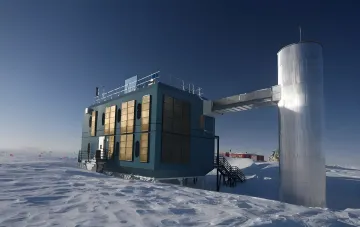
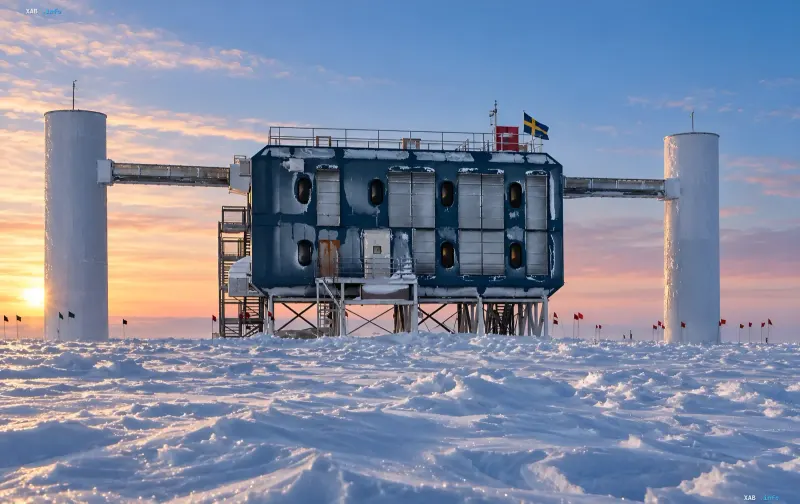
The existence of neutrinos was first predicted by Wolfgang Pauli in the 1930s, but they were not experimentally confirmed until 1956 as part of Project Poltergeist. Today, the world's largest detector, IceCube, located in Antarctica, is used to detect them. It consists of thousands of light sensors submerged in a cubic kilometer of ice: when high-energy neutrinos collide with the ice, pale flashes of blue light occur — Cherenkov radiation. Meanwhile, the detector records only a few dozen ultra-powerful cosmic neutrinos per year.
A New Window Into the Early Universe
Neutrino research opens up a new window for humanity to study the first moments after the Big Bang and the early universe. In addition to the Antarctic detector, ancient neutrinos are being studied by the Simons Observatory in the Atacama Desert, which investigates the cosmic microwave background. The combination of these data allows scientists to recreate a picture of the earliest stages of cosmic evolution.