Astronomers have recorded a phenomenon unique to the Solar System: the periodic comet 41P/Tuttle-Giacobini-Kresák has not only slowed its rotation but completely reversed it, beginning to spin in the opposite direction. According to Professor David Jewitt from the University of California, Los Angeles, this is the first scientifically documented case of a comet reversing its spin direction. The discovery was made possible by a re-analysis of archival observations gathered back in 2017.
How the Spin Reversal Was Discovered
Comet 41P orbits the Sun approximately every five years, and its nucleus has a diameter of just about one kilometer. Following its close approach to the Sun in 2017, ground-based telescopes and the Swift space observatory recorded an anomaly: the comet's rotation abruptly slowed by about threefold. However, the full picture only emerged later when researchers re-examined Hubble Space Telescope images from December 2017 retrieved from the Mikulski Archive for Space Telescopes, revealing that the body had not only slowed down but actually spun backward.
Why It Happened
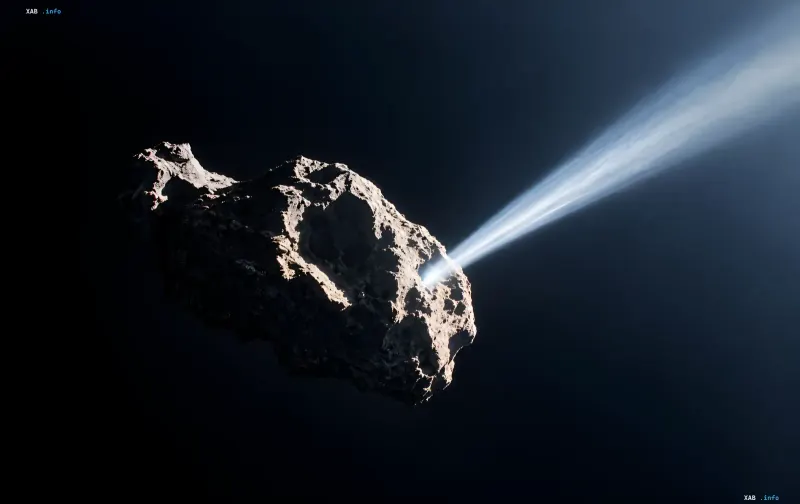
According to scientists, vigorous gas activity caused the shift. Due to its extremely small size, the nucleus of 41P is highly vulnerable to centrifugal forces: powerful jets of gas and dust create an asymmetric "jet" effect capable of restructuring the body's rotation. Researchers believe that such activity and the resulting spin reversal could eventually tear the icy body apart, turning it into a debris field.
Three Independent Discoveries
The comet has an unconventional background. It was independently discovered three times: by Horace Tuttle in 1858, Michel Giacobini in 1907, and Lubor Kresák in 1951. Observers later correlated these findings and unified them into a single orbit, giving the object its modern triple name. Thus, a body known to science for nearly a century and a half continues to provide groundbreaking data.
Significance for Science
Currently, 41P provides astronomers with a rare opportunity to study how internal activity destabilizes small bodies in the Solar System and why some of them ultimately self-destruct during their journeys through the planetary system. The recorded spin reversal serves as a vivid example that even seemingly "calm" comets can undergo drastic dynamic changes when approaching a star.