Some comets passing close to Earth have the potential to pose a threat to life on the planet, yet their origin and the mechanisms behind their appearance in the inner Solar System remain a subject of active scientific debate. One of the most discussed scenarios has been put forward by physicist Richard Muller, who suggests that the orbits of billions of icy bodies in the distant regions of the Solar System are periodically “perturbed” by an invisible companion star to the Sun—a hypothetical object known in astronomical literature as Nemesis. According to his calculations, the gravitational influence of this body triggers prolonged comet showers that can have catastrophic consequences for Earth's biosphere.
The Nemesis Hypothesis: A Red Dwarf on an Elongated Orbit
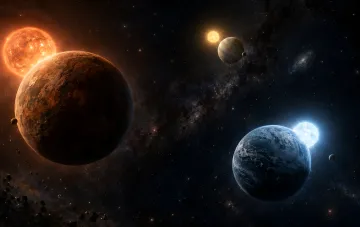
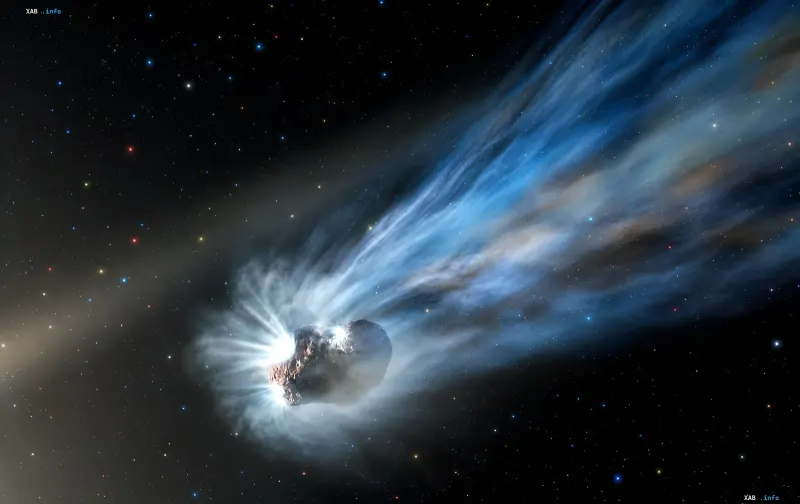
According to Muller's model, Nemesis is a red dwarf with a mass of at least five percent of the Sun's mass. This object moves along a highly elongated orbit around the common center of mass (barycenter) of the Sun-Nemesis system. As it approaches the densest part of the Oort Cloud—a hypothetical reservoir of icy bodies extending, according to astronomical estimates, up to 1.6 light-years from the Sun—the star's gravity disturbs the orbits of billions of cometary nuclei and directs a significant portion of them toward the inner Solar System. This mechanism, the researcher believes, explains the periodic increase in the flux of long-period comets observed in the planet's history.
Cyclical Extinctions: Every 26 Million Years
Muller links his hypothesis to paleontological and geological record data indicating a possible periodicity of mass extinctions on Earth with a cycle of roughly 26 million years. According to his calculations, such a pattern could have persisted over the past 250 million years. Unlike random close encounters of the Solar System with other stars, which would occur chaotically, the influence of Nemesis, moving along a defined orbit, should repeat with predictable regularity. One such period, according to the researcher, occurred at the Cretaceous-Paleogene boundary—about 66 million years ago, when dinosaurs and a significant portion of other species went extinct.
Dinosaurs: Comet or Asteroid?
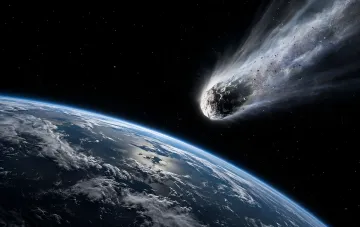
The scientific community's widely accepted version states that the Cretaceous-Paleogene extinction was triggered by the impact of an asteroid 10 to 15 kilometers in diameter near the modern Yucatán Peninsula, where the Chicxulub crater, about 200 kilometers across, is preserved. However, Muller suggests that the cause of the disaster might have been not a rocky asteroid, but an icy comet arriving from the outer regions of the Solar System. At the same time, the researcher notes that the consequences of celestial bodies of comparable size colliding with the planet's surface can be so similar that unambiguously distinguishing the nature of the impactor from surviving geological traces is extremely difficult.
Why Nemesis Cannot Be Detected
The main argument of skeptics who doubt the existence of Nemesis is that a normal red dwarf with the stated mass should have been spotted by modern telescopes long ago. However, as Muller points out, the object moves together with the Sun around the common barycenter, which keeps its proper motion against the background of distant stars minimal, significantly hindering its discovery through astrometric methods. Furthermore, at the current stage of its orbit, the star may be located at a distant point of the ellipse where its visible brightness is extremely low. The question of the origin of the Oort Cloud itself also remains open: it is believed to have formed from planetesimals of the early Solar System, material from neighboring stars in the Sun's natal stellar cluster, and captured interstellar objects.
The Vera Rubin Observatory and Prospects for Testing the Hypothesis
Astronomers hope to obtain more data on the distant regions of the Solar System thanks to the Vera Rubin Observatory, which conducts systematic sky mapping and makes it possible to discover significantly more long-period comets than previous surveys. Precise determination of their orbits and spatial distribution will make it possible to test hypotheses regarding the origin of these objects and the potential gravitational influence of other stars upon them, including the hypothetical Nemesis. If the statistics of cometary orbital parameters indicate directed perturbation from a specific direction, this will become an indirect but substantial argument in favor of Muller's model.
How Real Is the Threat to Earth?
Despite the dramatic nature of the scenario, there is no immediate threat to humanity in the foreseeable future. According to researchers' estimates, the next large-scale comet shower capable of causing serious damage to the planet could occur no earlier than 12 to 15 million years from now. Thus, Muller's hypothesis, even if confirmed, describes a process belonging to deep geological time rather than the modern timeline. Nevertheless, the debate surrounding Nemesis and the role of comets in the history of the biosphere remains one of the most discussed topics at the intersection of astrophysics, paleontology, and planetary science, and new data from the Vera Rubin Observatory could significantly change the picture in the coming years.