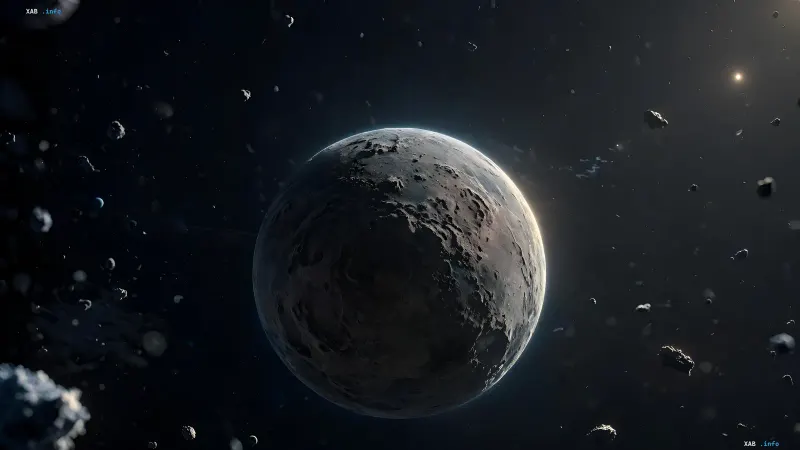
A team of astronomers from Japan's Kindai University, the University of Washington, and the University of Southern Queensland has published numerical simulation results pointing to the possible existence of a hypothetical object — Planet X2 — at the edge of the solar system. This is not the long-discussed Planet Nine, but a separate body with a mass of about two Earth masses, whose orbit lies at a distance of 350–500 astronomical units from the Sun. For context: Neptune, the outermost recognized planet, orbits at approximately 30 AU from the star, and the closest point of Planet X2's orbit would still remain 200 times further from the Sun than Earth.
Anomalous orbits as a clue
The research was spurred by the unusual trajectories of trans-Neptunian objects (TNOs) — small icy bodies orbiting beyond Neptune. Some of these move in highly elongated ellipses, others at large angles to the ecliptic plane where the major planets reside. Even at perihelion, these objects remain hundreds of AU from the Sun. Among the most famous examples are Sedna and 2012 VP113, whose orbital parameters do not fit standard models of solar system evolution and are not explained by Neptune's gravitational influence.
Four and a half billion years of simulation
To test whether an additional massive object in a distant orbit could explain the observed pattern, scientists performed numerical simulations of the solar system's evolution over 4.5 billion years. The calculations accounted for the migration of giant planets, including the gradual displacement of Neptune under the influence of numerous small bodies and Pluto-sized objects. The results were then compared with scenarios where one additional massive body was added to the four known giants. Models including Planet X2 produced populations of trans-Neptunian objects that matched real-world observations much better: the hypothetical planet helped explain distant bodies with low orbital inclination, objects with extremely large perihelion distances, and populations with highly inclined trajectories. The models also reproduced the orbital characteristics of Sedna, 2012 VP113, and 2015 BP519.
Model parameters and limitations
The best-fitting results yielded parameters of about two Earth masses, a semi-major axis of 350–500 AU, a minimum distance to the Sun of about 200 AU, and an orbital inclination of 1–15°. However, the authors honestly point out the limitations: when compared with data from the Dark Energy Survey (DES), the calculations reproduced orbital inclination and perihelion distance distributions well, but the distribution of semi-major axes of the detected objects did not entirely match observations. The model, as the researchers themselves admit, requires further refinement.
Planet X2 and Planet Nine: Two distinct hypotheses
It is important to emphasize that Planet X2 and Planet Nine are not the same thing. Planet Nine assumes the existence of a more massive object, 4–6 times heavier than Earth, which is meant to explain different orbital synchronization features of distant bodies. The new work examines these scenarios separately: the potential presence of one planet does not exclude the other object, although neither has been confirmed by direct observation. Both hypotheses remain working models supported by indirect orbital anomalies.
Verification: Vera Rubin Observatory
The Vera Rubin Observatory in Chile, which began operations in 2025, will play a key role in testing the hypothesis. Its digital camera, the largest in the world, images the entire sky every three days, allowing for the detection of significantly more trans-Neptunian objects than previously possible. It is this statistically representative sample of distant bodies that will make it possible to verify whether their orbital distribution matches the predictions of the Planet X2 model. Until these data are obtained, the existence of the object remains a theoretical construct, albeit one supported by the most consistent numerical description of anomalous populations beyond Neptune to date.