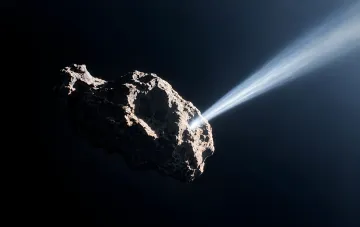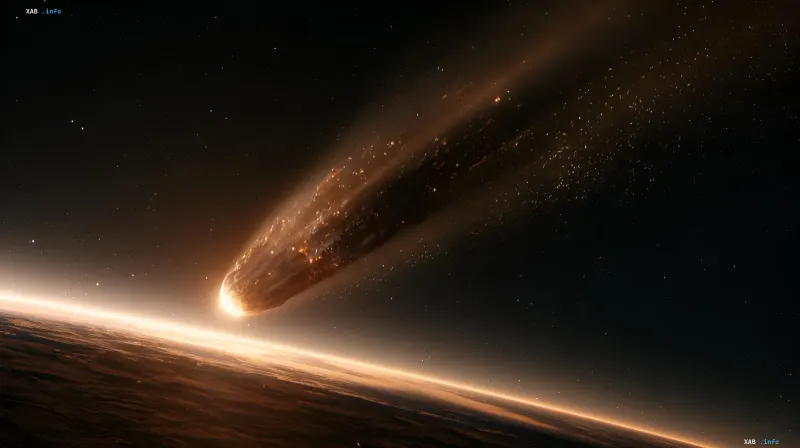
In November 2026, a Russian team of astronomers published the results of an analysis of the light signature of the interstellar comet 3I/ATLAS — the third object in the history of astronomy to arrive from outside the Solar System after 'Oumuamua and 2I/Borisov. The research was conducted by experts from the Crimean Astrophysical Observatory of the RAS, the Institute of Astronomy of the RAS, and the Special Astrophysical Observatory of the RAS. The key finding: the comet's dust particles scatter solar radiation in a fundamentally different way than any known comets in our system, including the other interstellar visitor, Borisov. This, according to the authors, indicates a unique chemical composition and internal structure of material formed in another planetary system.
Light Signature: How Dust Reveals Alien Origin
To interpret the observations, scientists modeled light scattering by irregularly shaped particles. The best fit to the data was provided by a model in which 95% of the dust component consists of amorphous carbon, 4.5% of magnesium-containing silicates, and only 0.5% of water ice. For comparison: typical comets in the Solar System are dominated by silicates and ices, while carbon accounts for an insignificant fraction. Photometric measurements additionally revealed an unusual combination of colors: in the short-wavelength part of the visible spectrum, the scattered light appears bluer, and in the long-wavelength part, it appears redder compared to solar radiation. Such a "cross" spectral response is difficult to reproduce with standard mixtures of ice and silicates.
Gas Coma and Extreme Formation Conditions
Parallel studies of the gas coma, including using the James Webb Telescope, showed that water in 3I/ATLAS is present in negligible quantities, while carbon dioxide (estimated at up to 50%) and carbon monoxide (up to 30%), which became the most common component after passing perihelion, dominate. A volatile gas fraction of no more than 5% is typical for comets in our system. The totality of the data suggests that the object formed in the cold peripheral zone of an alien planetary system, at temperatures below minus 240 °C, far from the warming effects of a star, and did not participate in the formation processes of young worlds. The comet's nucleus, about a kilometer in diameter, flew between the orbits of Mars and Earth in October 2025, and it was detected back in July 2025.
Observation Methodology and Activity Dynamics
Photometric and spectral measurements were conducted using three Russian telescopes with diameters of 2, 2.6, and 6 meters, which allowed for cross-verification of results and a reduction in systematic errors. Astronomers emphasize that dust properties can change over time as the comet moves away from the Sun and its coma disperses, so the current composition model is a snapshot of a specific stage in the object's evolution. Remarkably, 3I/ATLAS maintained high dust activity even after passing perihelion — the point in its orbit closest to the Sun, which is itself atypical and requires continued monitoring.
Significance of the Result and Prospects
The confirmed speed of the object — about 58 km/s relative to the Sun, significantly exceeding the threshold of about 42 km/s necessary for escaping the gravitational influence of our star, firmly established 3I/ATLAS as an interstellar visitor. The obtained "light signature" of the dust becomes a new tool for comparing formation conditions in different planetary systems: if the hypothesis of carbon dominance is confirmed in further observations, this will be direct evidence that other stellar systems contain types of cometary matter absent in the Solar System. The group of authors intends to continue monitoring the spectral changes as the comet heads into interstellar space.