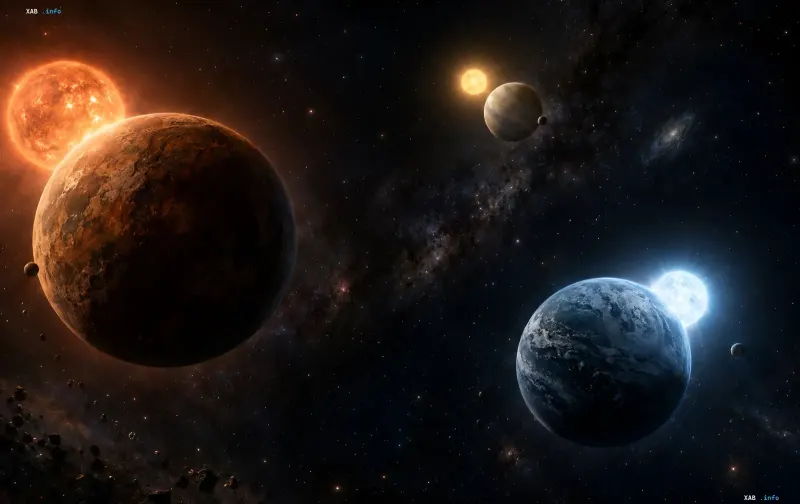
Astronomers have discovered three planetary systems where planets survived despite their host stars passing through the red giant phase—a stage where a star swells so massively that, according to classical models, it should completely consume nearby worlds. This was reported by a research team led by Qian Shenbang from Yunnan University, working with data from NASA's TESS space telescope. The discovery challenges established notions that any close-in planet is inevitably destroyed when a star expands.
Three Anomalies in the Northern Sky Cluster
The researchers focused on stars that have already passed the peak of their expansion and re-contracted to more compact sizes. This made it possible to evaluate what happened to close-in planets at the moment of the star's maximum swelling. By analyzing TESS data, the scientists identified three similar systems in the northern sky cluster, each containing a massive planet on a very tight orbit—one that, according to calculations, should have been completely obliterated during the star's expansion.
Star 24 Bootis: The Riskiest Case
The most telling object in the sample is the star 24 Bootis, located about 300 light-years from Earth. According to the researchers' estimates, during the red giant phase, this star expanded more than 100 times compared to the Sun's current size. At this scale of expansion, the orbit of any massive planet orbiting closely should have ended up deep inside the star's photosphere. Nevertheless, the planet in this system survived, making the 24 Bootis case the most paradoxical from the standpoint of classical astrophysics.
From Isolated Case to Regularity
Prior to this discovery, astronomers knew of only one such case—a system in the constellation Ursa Minor described in 2023. The detection of three new anomalies in a single data run allowed scientists to draw a fundamentally different conclusion: this is not a statistical coincidence, but the result of specific physical mechanisms that are not yet fully formalized. This means that planet survival during stellar expansion may not be an exceptional event, but a regular process governed by specific laws of dynamics and mass transfer.
What This Means for the Solar System
According to modern stellar evolution models, in about five billion years the Sun will exhaust the hydrogen in its core, transition into the red giant phase, and engulf Mercury and Venus, while turning Earth into a scorched rock devoid of atmosphere and liquid water. The new research shows that the long-term fate of planetary systems is significantly more complex than classical models assumed: even on tight orbits, planets can survive thanks to mechanisms that have yet to be precisely described. Shenbang's team plans to test various survival scenarios, as understanding these mechanisms will allow for more accurate predictions of the evolution of not only exoplanetary systems, but our own Solar System as well.
Open Questions
Currently, scientists do not have an exact answer as to how the planets in the three discovered systems managed to survive stellar expansion. Possible hypotheses include orbital changes driven by tidal forces, mass redistribution during stellar mass loss, and the influence of neighboring bodies in the system. Each of these assumptions requires further verification using more precise observation data. Nevertheless, the very fact of discovering three systems with a similar anomaly is already a significant result, indicating that existing models of planetary system evolution need to be revised.