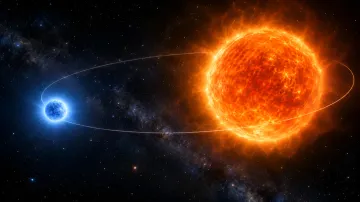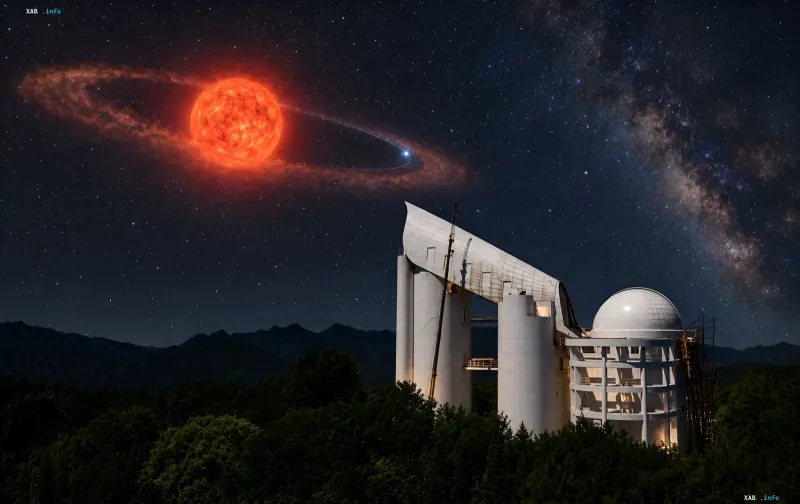
Astronomers have reported the discovery of an anomalous binary star system, designated J0008+0128, in which a visible red giant revolves around an invisible cosmic object. The results of the study were published in the journal Science Advances, as reported by RBC-Ukraine. The key feature of the system is that the mass of the invisible companion is so atypical that scientists cannot yet definitively determine its nature: it is either an extremely heavy neutron star or a black hole with an anomalously low mass. In both cases, the object fits into the so-called "mass gap," where, according to existing models, neither should exist.
What is the "mass gap" and why is it important?
To understand the significance of the find, it is necessary to recall the basic parameters of the two types of compact objects. Neutron stars are the remnants of massive stars that explode and contract at the end of their life cycle; with a mass of about 1.4 solar masses, they form a sphere about 20 kilometers in diameter. Black holes are formed from even more massive predecessors and have a mass of at least five solar masses. Since scientists have not been able to record a neutron star heavier than 2.5 solar masses in practice, there is an empty range between the two classes of objects—from 2.5 to 5 solar masses—which is called the "mass gap" in scientific literature. The companion in the J0008+0128 system is estimated in the range of 1.8 to 2.8 solar masses, placing it at the upper limit of this interval and making the find exceptionally valuable for studying stellar evolution.
Why the companion cannot be a normal star
Researchers established that the pair revolves around a common center of mass with a period of about 3.3 years, with the orbit being nearly circular, despite the significant distance between the components. A decisive argument against the hypothesis of a normal star is the absence of any additional light emission: astronomers recorded only the radiation of the red giant. Furthermore, in such binary systems, neutron stars usually pull matter from a partner, increasing their own mass; however, in the case of J0008+0128, the invisible object is located too far away to absorb material from the red giant. This excludes a number of standard formation scenarios and increases the mysterious nature of the system.
Why 300,000 simulations did not provide an answer
To understand the origin of such a "union," researchers conducted over 300,000 computer simulations of the evolution of binary and triple systems. No model could fully explain both the mass of the invisible object and its orbital characteristics simultaneously. The closest known analog in the catalog is the Gaia NS1 system, containing a neutron star with a mass of about 1.9 solar masses, but the new object proved to be significantly more extreme and does not fit into the framework that describes this analog. It is the inability of existing models to reproduce the observed parameters that turns J0008+0128 into an object that requires a revision of part of our theoretical understanding.
What explanations are scientists considering?
Among the possible interpretations, researchers are considering the hypothesis that the system is actually a triple one. Specifically, the invisible object could have formed as a result of the merger of two very close, low-mass neutron stars, or a neutron star and a white dwarf that once combined into a single compact object. Alternatively, the object could be a black hole with a mass below the traditionally accepted threshold of five solar masses. Until additional observations are obtained, none of these versions can be either confirmed or rejected definitively.
One way or another, the discovery of J0008+0128 is an important step in the study of compact stellar remnants and the boundaries between their classes. The system is located in a zone where the current astrophysical picture looks incomplete, and it is precisely such "awkward" objects that usually stimulate the development of new models for binary system evolution. Further observations and refinement of the invisible companion's mass will allow astronomers to determine whether the find is an exception that expands known limits or a sign that the "mass gap" itself requires revision.