The European Southern Observatory (ESO) has announced the discovery of a previously unknown star, S301, in the center of the Milky Way. At its closest approach to the supermassive black hole Sagittarius A* (Sgr A*), the star accelerates to roughly 25,000 kilometers per second. This amounts to about 8% of the speed of light and is a record value among all stars known to date. The discovery was made possible by the GRAVITY infrared interferometer, installed on the Very Large Telescope (VLT) in the Chilean Atacama Desert, which is capable of tracking the position of even faint objects in the densely star-filled core of the Galaxy with exceptional precision.
Tight Orbit and Record Acceleration
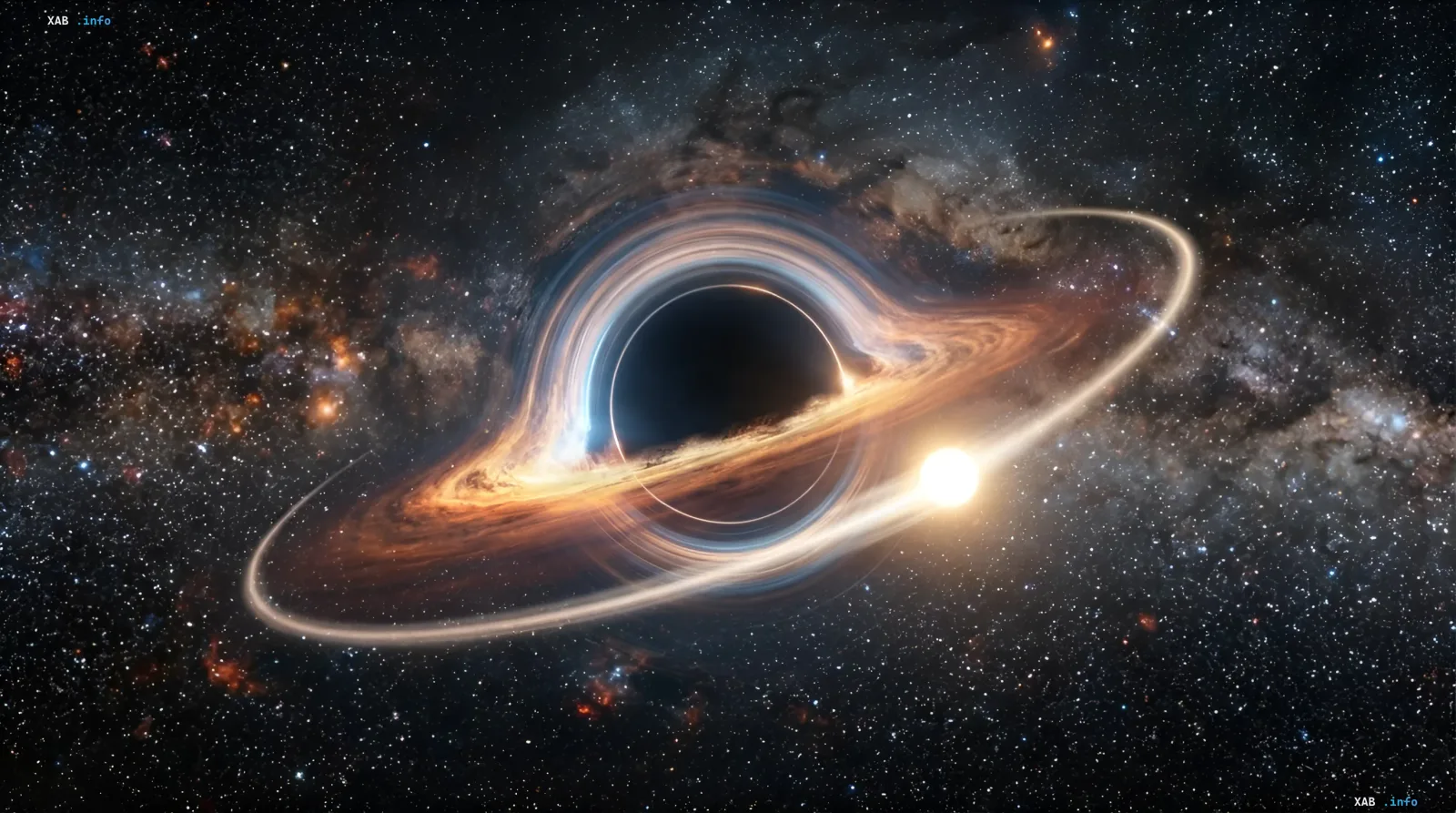
S301 moves along an extremely tight orbit around the central black hole of our Galaxy, completing a full revolution in just 8.7 years. For comparison: one of the best-known stars in the vicinity of Sgr A* — S2 — takes about 16 years to complete the same orbit. At pericenter, i.e., the point of closest approach, the star passes at a distance of roughly 12 astronomical units from the black hole. Since one astronomical unit equals the average distance from Earth to the Sun — about 150 million kilometers — at the closest point of its orbit S301 and Sgr A* are separated by approximately 1.8 billion kilometers. It is precisely in this region that the colossal gravity of the black hole accelerates the star to a record 25,000 km/s (equivalent to nearly 90 million km/h).
How the Object Was Found and What Kind of Star It Is
After the initial detection of S301 using GRAVITY, the scientists turned to analyzing archival observations, which allowed them to reconstruct the object's history and determine its nature. According to the data obtained, S301 is a relatively small Sun-like star captured by the gravity of the supermassive black hole. The high sensitivity of the interferometer in the infrared range proved to be a decisive factor: in the dense center of the Galaxy, where thousands of stars overlap one another, only such a high-resolution technique makes it possible to isolate and precisely measure the motion of an individual faint object.
Testing the Theory of Relativity and Measuring the Black Hole's Spin
The scientific value of the discovery goes far beyond the mere fact of a record speed. Thanks to its short orbital period and extreme close approach to Sgr A*, the motion of S301 experiences strong relativistic effects, making it an ideal natural testbed for new high-precision tests of Einstein's general theory of relativity and for refining the characteristics of the central black hole. Particular importance is attached to the task of measuring the spin of Sgr A*: according to Felix Mang of the Institute for Extraterrestrial Physics, observations of S301 may allow the rotation speed of the supermassive black hole at the center of the Milky Way to be determined directly for the first time within the next decade. Without this star, obtaining comparable data on other objects would require several decades of observations.
Significance of the Discovery for Astrophysics
Thus, S301 becomes not just the "fastest star" in the catalog, but a unique tool for studying one of the most extreme gravitational fields in the Universe. The combined data on its orbit will allow a simultaneous test of the predictions of relativistic physics in a strong field and the removal of one of the key limitations in our understanding of the nature of Sagittarius A*. For the scientific community, the discovery means that a series of precise measurements, previously considered unattainable in the foreseeable future, can be expected in the coming years.