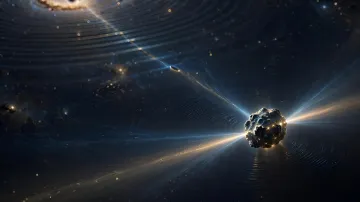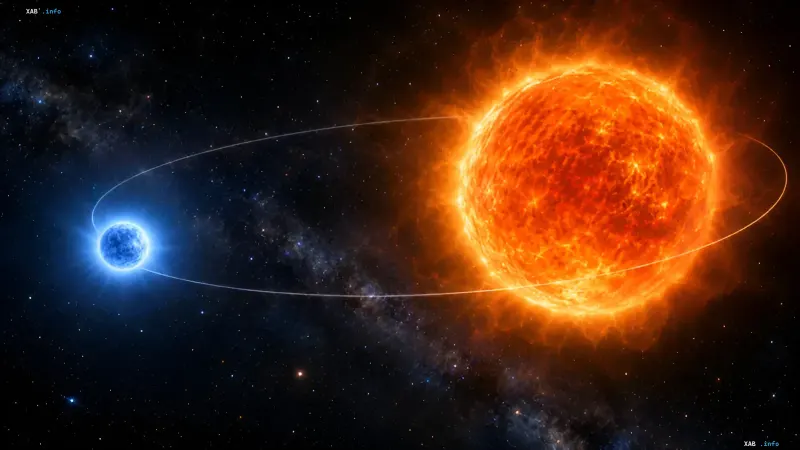
Astrometric data from the European space satellite Gaia have led astronomers to discover a compact object designated J0008+0128, located several thousand light-years from Earth. The estimated size of this object is about 20 kilometers, making it invisible to direct observation from such a distance. The research is based on a joint analysis of spectroscopic and astrometric data, with the object's gravitational partner—a red giant, which is easy to observe—playing a key role in determining the parameters. According to data from the LAMOST and SDSS/APOGEE surveys, as well as observations from the Nordic Optical Telescope (NOT), researchers successfully measured the radial velocity of the red giant, while Gaia's astrometric measurements helped determine the system's orbit parameters. High-resolution spectrum analysis confirmed the absence of spectral lines from a second star, providing convincing evidence of the invisible compact object's presence.
Parameters that defy standard models
The mass of the red giant is estimated between 1.2 and 2.7 solar masses, while the invisible companion yields a range of 1.8 to 2.8 solar masses. The system's orbital period is approximately 1,220 days with an eccentricity of about 0.1, indicating a nearly circular orbit. Critically, the orbit is too large for the supermassive compact object to accrete mass from its companion and grow to its measured size. It is this combination of the compact object's large mass and the significant distance between the components that makes the J0008+0128 system anomalous within modern stellar evolution theories.
Thousands of simulations yield no answers
The study's authors tested possible system evolution scenarios using thousands of computer simulations, including POSYDON binary star evolution models. None of the ran models could reproduce the observed physical and orbital characteristics of J0008+0128. If the companion is indeed a neutron star, it belongs to an exceptionally massive class of objects never before observed in nature or reproduced in theoretical models. The object literally defies modern understandings of stellar system evolution.
Hypotheses and prospects
Researchers are considering several working hypotheses. The first suggests the formation of an unusually massive neutron star directly during a supernova explosion. The second suggests the past existence of a triple system in which two inner components subsequently merged—either a neutron star with a regular star or two neutron stars. Refining the object's parameters, if it is indeed a supermassive neutron star, will provide a series of constraints for defining the boundary between neutron stars and black holes, as well as better understanding the differences between supernova explosions that result in different types of compact remnants.
Significance for astrophysics
If J0008+0128 is confirmed as a neutron star, the new data will provide insight into the density of its matter and its ability to resist gravitational collapse into a black hole. For the first discovered supermassive object in the stellar remnant category, this will be a true discovery capable of advancing our understanding of the Universe and potentially leading to the discovery of new physical phenomena beyond existing theoretical frameworks.