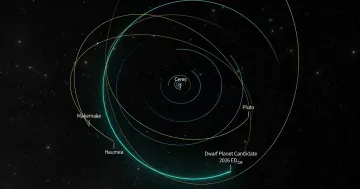
The Vera C. Rubin Observatory has recorded the existence of a large cosmic body on the outer periphery of the solar system, designated with the provisional index 2026 ED138. The new object is located at a distance of about 6.92 billion kilometers from the Sun and has become the largest discovery among nearly 2,300 trans-Neptunian bodies identified during recent southern sky surveys. The discovery expanded scientific understanding of the system's boundaries by approximately 50 percent.
Characteristics and parameters of the new cosmic object
The exact dimensions of 2026 ED138 remain subject to calculations and depend on the surface reflectivity coefficient. If the ice or material on the body has high reflectivity, the object's diameter is about 595 kilometers. With a dark surface, the diameter estimate increases up to 1,497 kilometers, which is comparable to known dwarf planets like Haumea and Makemake.
The celestial body's orbit features a pronounced elliptical shape and is inclined at an angle of nearly 25 degrees relative to the plane of the main planets' ecliptic. Analysis of the trajectory indicates that the object may have formed in the inner solar system near Jupiter and Saturn, from where it was subsequently pushed out by the gravitational forces of the giants.
Context of studying trans-Neptunian objects
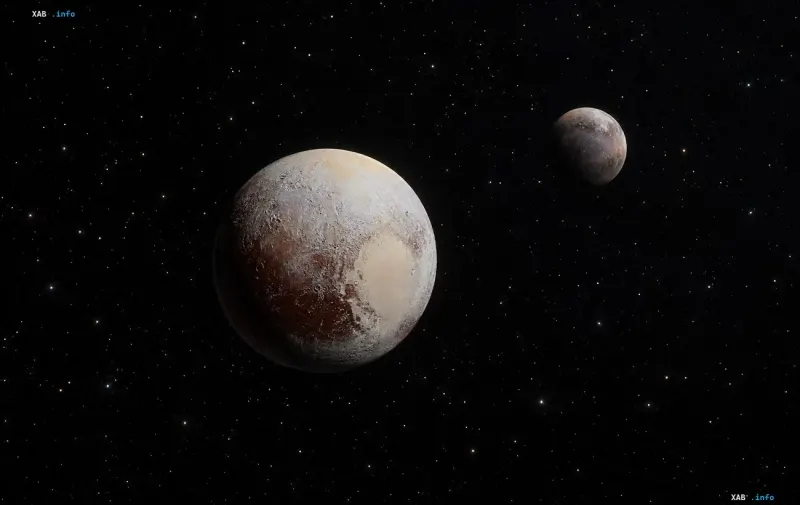
The events of 2006, when the International Astronomical Union reclassified Pluto into the category of dwarf planets, established clear criteria for such objects. They must possess sufficient gravity to maintain a rounded shape while lacking the ability to clear their orbital zone of other large bodies. 2026 ED138 fits fully into this scientific paradigm.
The large-scale sky survey by the Rubin Observatory confirms astronomers' hypotheses regarding the potential existence of other massive and yet undiscovered bodies in the Kuiper Belt and beyond. These include potential Mars-sized candidates or even larger objects hiding in deep space.
Further research and scientific plans
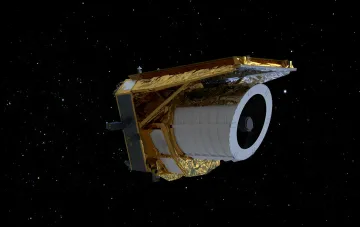
In the near future, the astronomical community intends to deploy the JWST space telescope for a detailed study of the discovered candidate. Scientists plan to record the potential presence of satellites around 2026 ED138, which will allow for the precise calculation of the cosmic body's mass and density.
Additionally, researchers intend to study the composition of the atmosphere and surface layer by observing the object passing against the background of distant Milky Way stars. This data will help reconstruct the early migration history of giant planets and the evolution of the solar system's outer frontiers.