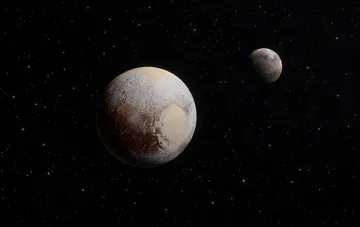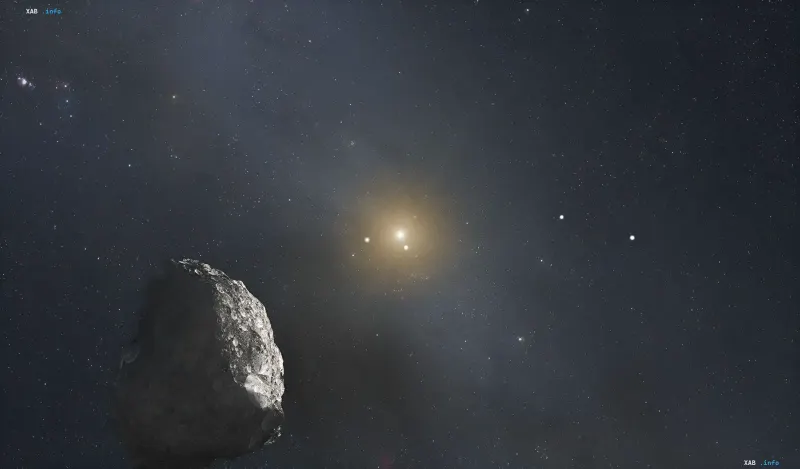
Scientists at NASA's Johnson Space Center in Houston, alongside colleagues at the University of California, Los Angeles (UCLA), have reported the discovery of mineralogical evidence for an ancient ice reservoir in the Kuiper Belt—the region beyond Neptune's orbit populated by numerous icy bodies. The key material for the study consisted of 12 cosmic dust particles collected in Earth's stratosphere by the ER-2 research aircraft. Chemical traces of water interacting with dust grains during the early stages of the Solar System's formation were identified within the minerals of these particles, and the oxygen isotopic composition indicated that this water was enriched with heavy isotopes, a characteristic typical specifically of outer Solar System material.
How Stratospheric Dust Became the Key to the Kuiper Belt
The origin of the studied particles was established thanks to traces of energetic solar particle impacts—high-energy ions emitted by the Sun. The high concentration of such tracks in the mineral matrix allowed researchers with a high degree of confidence to link these grains to the Kuiper Belt rather than to sources of cosmic dust closer to Earth. For detailed analysis, the team employed electron microscopy and an ion microprobe, methods that make it possible to simultaneously determine the mineral composition of the particles and precisely measure the ratio of oxygen isotopes in individual crystallites. It was the combination of these two approaches that made it possible to identify minerals formed through water-dust interactions in the early Solar System and record their anomalous isotopic characteristics.
The Isotopic 'Fingerprint' and Genesis Mission Data
To correctly interpret the obtained isotopic measurements, the scientists utilized data from NASA's Genesis mission, which in 2004 collected solar wind particles to determine the isotopic composition of the Sun's own material. Comparison with this benchmark showed that the discovered minerals carry an isotopic signature extremely rare in meteorites falling to Earth. This rare match aligns with the established assumption that the giant planets—Jupiter and Saturn—acted as a barrier limiting the mixing of material between the outer and inner regions of the Solar System. As a result, the icy material of the Kuiper Belt preserved its isotopic specificity without being completely 'blurred' by mixing with inner system material.
Decades of Hypotheses and a New Level of Evidence
The hypothesis regarding the existence of a separate ice reservoir in the outer Solar System has been put forward for several decades. Previously, indirect evidence was recorded through the study of meteorites and samples returned from carbon-rich asteroids, but the volume and precision of such data remained insufficient for a definitive conclusion. The new results obtained from 12 stratospheric particles complement the existing picture and allow researchers to trace the origin of material that directly participated in planet formation. Essentially, the scientists obtained a 'slice' of the chemistry that dominated the distant outskirts of the protoplanetary disk billions of years ago, before the dynamics of giant planet orbits redistributed the material across the entire system.
Significance for Modeling the Early Solar System
The discovery of heavy oxygen isotope-enriched ice in particles physically linked to the Kuiper Belt provides a quantitative basis for revising models of migration and thermal history in the outer regions of the Solar System. If the icy material indeed maintained an isolated isotopic composition for billions of years, this imposes strict constraints on the speed and scale of mixing permissible in existing hydrodynamic and N-body simulations. Further research, including expanded collections of stratospheric dust and sample analysis planned for next-generation missions, will help refine the timeline of the formation of Kuiper Belt icy bodies and their role in the water budget of terrestrial planets.