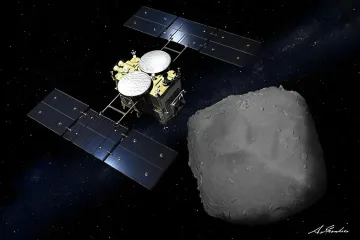
The European Space Agency (ESA) has published new images of the binary asteroid system Didymos–Dimorphos, captured by the Hera probe during its flight toward the target. The Asteroid Framing Camera (AFC) operated from a distance of 28,5 km from the asteroids, providing a spatial resolution of about 2.7 meters per pixel. The published frames clearly distinguish the larger asteroid Didymos, with a diameter of about 780 meters and a prominent equatorial ridge, as well as its moon Dimorphos, with a diameter of about 151 meters, which is almost completely hidden in shadow in regular optical images but clearly visible in thermal imagery.
Three Instruments — Three Dimensions of the Surface
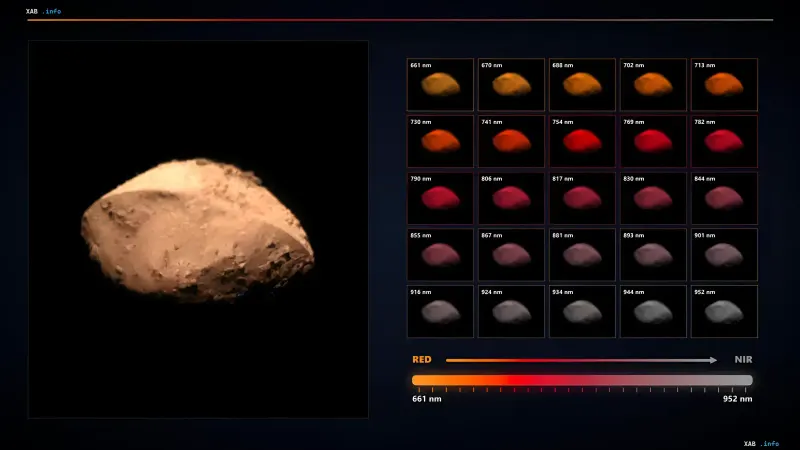
The capabilities of the Hera probe are not limited to standard imaging. The HyperScout H spectrometer analyzes the light reflected by the asteroids across 25 spectral bands ranging from visible light to near-infrared, which is invisible to the human eye. By comparing the obtained spectra with laboratory measurements of meteorites and minerals, scientists determine the chemical and mineralogical composition of the surface. The second key instrument, the TIRI thermal imager developed with the participation of the Japan Aerospace Exploration Agency (JAXA), measures thermal radiation and creates temperature maps. Based on the temperature distribution, researchers will be able to distinguish solid, porous, and fragmented rocks, as well as loose material down to dust.
Didymos' Equatorial Ridge and the Question of Its Origin
The images of Didymos clearly show a characteristic structure — an equatorial ridge stretching along the asteroid's equator. According to Hera Science Lead Patrick Michel, the rapid rotation of Didymos around its own axis — with a period of approximately 2.2 hours — may contribute to the migration of material toward the equator and the formation of precisely this topography. The hypothesis links the centrifugal forces arising from rapid rotation to the gradual accumulation of fine soil and debris in the equatorial zone. Confirming or refuting this model will be one of the tasks of detailed Hera data analysis.
Context: How DART Changed Dimorphos
The Didymos–Dimorphos system became the subject of the world's first targeted asteroid deflection experiment. In September 2022, NASA directed the 580-kilogram DART spacecraft into Dimorphos at a speed of about 6.1 km/s. The collision altered the moon's orbit around Didymos, shortening its orbital period by approximately 33 minutes. The resulting ejecta cloud stretched over 10,000 kilometers. Hera is tasked with studying these impact consequences up close: to determine whether a crater formed at the impact site or if the impact significantly altered the shape of the entire asteroid, as well as to determine the composition, internal structure, and mass of Dimorphos.
What's Next: CubeSats and Landing
Following the main survey phase, Hera will deploy two small CubeSats that will enter even closer trajectories for detailed observations. Their tasks include studying the surface followed by landing on the asteroid. Thus, the mission transforms into a comprehensive program: from orbital imaging and spectroscopy to direct surface contact. The data Hera transmits to Earth will become the first detailed portrait in history of an asteroid subjected to a controlled impact, making it possible to assess how effective the planetary defense strategy tested in the DART experiment really is.