NASA has officially concluded the science mission of the NICER (Neutron star Interior Composition Explorer) X-ray telescope, which was mounted on the exterior platform of the International Space Station. Over the course of its operation, the observatory became a key instrument in modern X-ray astrophysics, studying neutron stars containing the densest matter available for measurement, as well as black holes, active galactic nuclei, and other compact objects. Beyond its astronomical results, the mission also achieved an applied goal: validating X-ray pulsar navigation technology for deep space travel.
From an 18-month mission to eight years of operation
The telescope was launched in 2017 with an 18-month primary mission in mind. However, the instrument continued its scientific work for approximately 6.5 years beyond its initial term, making it one of the longest-lived scientific instruments ever installed on the station's exterior. Following eight years of observations, NASA and ISS crews are currently finalizing the archive of X-ray data, which will serve as a foundation for future scientific publications and analysis.
Motor malfunction and observation shutdown
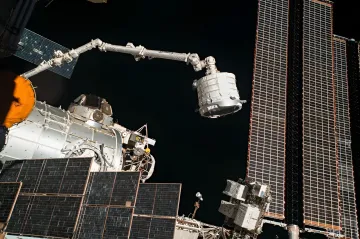
In June 2025, the telescope experienced a malfunction in one of its drive motors: the mechanism stopped rotating the observatory beyond its current position, which restricted its ability to point at celestial targets. On June 17, the team decided to cease data collection. Engineers reviewed images of the telescope captured by external robotic cameras on the ISS and ruled out external causes. The investigation concluded that an internal motor governing the telescope's movement had failed, and full pointing capabilities could not be restored.
Decommissioning and removal from the station
Work is currently underway to close out the eight-year archive of X-ray observations and prepare for the telescope's decommissioning. The plan is to set NICER into a non-operational configuration and detach its mounts near the ISS's starboard solar array. Once all data archiving procedures are complete, the instrument will be dismantled from the station's exterior platform.
Mission legacy: pulsar navigation and applied technologies
In addition to its astrophysical findings, the NICER mission demonstrated the viability of spacecraft navigation using X-ray signals from pulsars—rapidly rotating neutron stars with predictable emission patterns. This technology is potentially suitable for deep space missions to Mars and beyond, where traditional radio navigation loses precision. The technologies developed for testing also find applications in prototypes for portable CT scanners and material analysis systems, expanding the mission's impact far beyond pure astronomy.