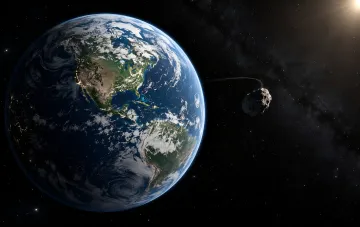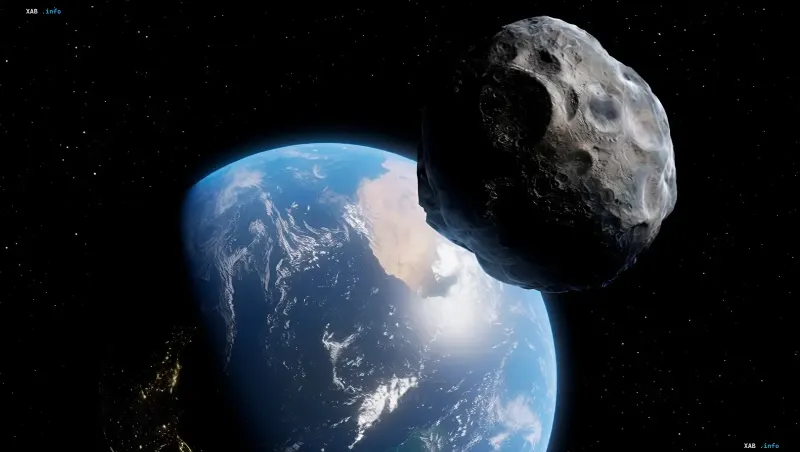
In October 2026, the International Astronomical Union's Minor Planet Center officially announced the discovery of a new temporary Earth satellite: asteroid 2026 QQ8. The object was first spotted back in August of this year by Hungarian astronomer Krisztián Sárneczky, but public confirmation of its status arrived only two months later. According to available estimates, the asteroid's diameter is just 1–2 meters, and its distance from Earth exceeds 500,000 km — significantly farther than the Moon. Astronomers believe the gravitational capture took place in April 2026, and within the next couple of months, the object will leave our planet's vicinity and return to a heliocentric orbit.
What Is a 'Mini-Moon' and How It Differs from a Quasi-Moon
The term 'mini-moon' is applied to small asteroids that temporarily fall into Earth's gravitational field and begin orbiting it as a full-fledged, albeit tiny, satellite. This fundamentally distinguishes them from so-called quasi-moons — asteroids that move in an orbit close to Earth's, but are not gravitationally bound to our planet. 'Quasi-moons are interesting because they don't orbit our planet the way the Moon does — they're just hanging out nearby,' explains Dr. Jennifer Millard, an astronomer, in a comment to the BBC. One prominent example of a quasi-moon is asteroid 2025 PN7, discovered in August 2025 and moving almost synchronously with Earth for several decades.
Rarity of the Phenomenon: Only Five Known Cases
According to the non-profit organization The Planetary Society, which promotes space research, prior to the discovery of 2026 QQ8, only four such temporary satellites had been recorded, and none of them are currently orbiting Earth. The last mini-moon, 2024 PT5, was observed in August 2024. It was about 10 meters long, and subsequent chemical composition analysis suggested the object might be a fragment of the Moon ejected into space as a result of an asteroid impact in the distant past. 2024 PT5 spent just a few months in Earth's vicinity before heading into deep space. According to several astronomers, it will make another close pass by our planet in 2055.
Are 'Ghost Moons' Dangerous to Humanity
Despite the fact that by astronomical standards these objects are relatively close, they never approach Earth closely enough to pose a threat. Even at their closest point, their distance from the planet is several times greater than the lunar distance. 'It's not like they come screaming out of the dark,' Dr. Millard explains. 'If they were coming toward us, it would happen very slowly; we would notice them in advance.' Thus, asteroid 2026 QQ8, like its predecessors, represents purely scientific interest rather than a potential danger to human civilization.
The Mystery of 'Ghost Moons' Remains Open
In addition to mini-moons and quasi-moons, scientific literature mentions so-called 'ghost moons' — hypothetical swirling clouds of cosmic dust moving in the same orbit as Earth and capable of staying ahead of or behind our planet. There is no unified scientific consensus on whether they actually exist yet. Dr. Millard notes that there is a huge amount of dust in interplanetary space, and she wouldn't be surprised if some of it gets trapped by gravitationally stable points in Earth's orbit. For now, however, no such object has been observationally confirmed, and 2026 QQ8 remains the first genuinely recorded temporary satellite of our planet in two years.