The Moon continues to shrink gradually due to the continuous cooling of its interior, a process that has been underway for about 4.5 billion years. Recent scientific research published in The Planetary Science Journal has allowed scientists to assess in detail the scale of this process and how much Earth's natural satellite has reduced in size over the past hundreds of millions of years.
Analysis of Lunar Reconnaissance Orbiter Images
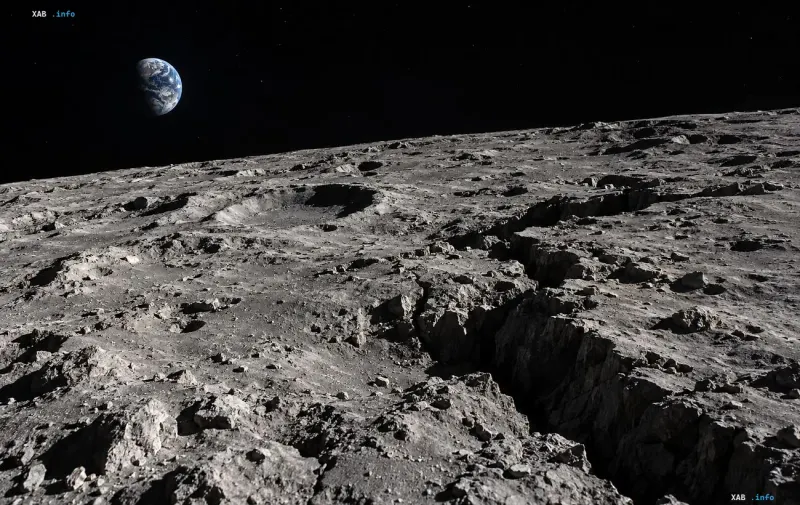
Researchers conducted a detailed analysis of high-resolution images captured by the Lunar Reconnaissance Orbiter Camera (LROC). During their work, more than 10,000 young faults, cracks, and tectonic deformations were recorded on the lunar surface. Based on these data, geologists calculated that over the past 400–800 million years, the overall radius of the Moon has decreased by approximately 45 meters.
According to scientists, as the internal interior continues to cool, the formation of new faults and the growth of existing structures persist to this day. Among the identified surface deformations, researchers documented 8,900 lobate scarps—long curved structures resulting from crustal compression—and 2,000 small ridges located within the dark maria plains of the satellite.
Characteristics of Lunar Tectonics and Crust
The tectonic activity of Earth's satellite differs fundamentally from terrestrial processes. While Earth's lithosphere is divided into approximately 15 massive tectonic plates, the lunar crust consists of a single solid shell. Consequently, cracks and faults do not concentrate along plate boundaries but are randomly distributed across the entire surface of the planetary body as a result of global global contraction.
Cartographic analysis demonstrated that the density of faults varies significantly across different regions of the Moon. In areas with a thicker crust, fewer cracks were recorded because in early history the robust rock layer better retained internal heat and delayed cooling. Instead, massive fault formation in those regions occurred later when internal cooling reached new stages.
Significance of the Cosmic Discovery for Science
The findings are of fundamental importance for understanding the evolution of not only the Moon but also other planetary bodies in the Solar System. Studying modern tectonic processes allows scientists to model more accurately the history of internal changes in cosmic objects lacking Earth-style plate tectonics. Further observations using automated orbiters will help refine the satellite's contraction rate and predict the emergence of new geological structures.