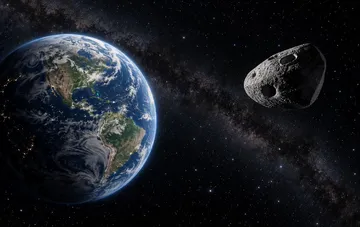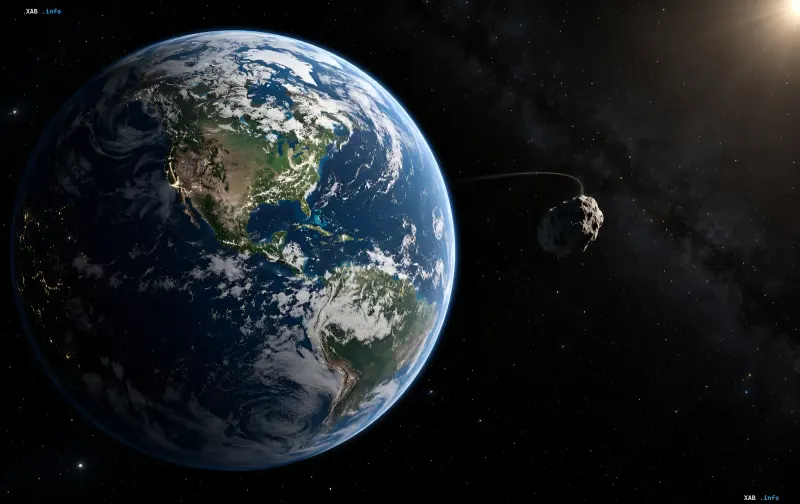
In November 2026, Earth acquired an additional natural satellite — a small asteroid named 2026 QQ8, which has entered a temporary orbit due to the planet's gravity. The Minor Planet Center has officially confirmed the object's natural origin and classified it as a temporary mini-moon of Earth. The asteroid will remain within the planet's gravitational field until the end of December, after which it will leave orbit and continue its independent journey around the Sun. As astronomers note, the object poses no threat to Earth: its trajectory completely rules out any risk of collision, and its tiny size would guarantee it burns up completely in the atmosphere even in a hypothetical entry into dense layers.
From rocket debris to confirmed asteroid
The discovery of 2026 QQ8 began on August 20, 2026, when Hungarian astronomer Krisztian Sarneczky first recorded an unusual object in the sky. Initial classification, as often happens with non-standard bodies in near-Earth space, suggested it was a piece of a rocket stage or a decommissioned satellite. However, subsequent observations conducted with the 2.2-meter telescope at the University of Hawaii and the Lowell Discovery Observatory refuted this hypothesis: spectral and morphological analysis clearly pointed to the body's natural origin. Based on this data, the Minor Planet Center officially recognized the object as an asteroid and granted it the formal status of a temporary Earth mini-moon.
How Earth's gravity 'caught' the asteroid
The scenario changed for 2026 QQ8 in April 2026, when the asteroid crossed the boundary of the so-called Hill sphere — a special zone around the planet within which Earth's gravitational influence outweighs the Sun's and allows it to hold foreign bodies in orbit. According to scientists' calculations, 2026 QQ8 approaches Earth roughly once every ten years. It last flew near the planet in 1965, but back then no gravitational 'capture' occurred — the object simply crossed near-Earth space and continued on. This time, the geometry of the approach was different: the asteroid entered the Hill sphere at an angle and speed that allowed Earth's gravity to hold it in an unstable orbit.
Looping orbit and safety questions
Despite its formal status as a moon, the orbit of 2026 QQ8 is highly unstable: the asteroid describes a complex loop around the planet rather than a classic elliptical trajectory. Its closest point of approach to Earth's surface is 0.0038 astronomical units, which is about 1.5 times the average distance to the Moon. Scientists emphasize that the object poses no danger. Firstly, the calculated trajectory completely rules out the possibility of a direct collision with the planet. Secondly, even in a hypothetical scenario of entry into dense atmospheric layers, the tiny size of the asteroid would cause it to burn up completely at a high altitude without any consequences for the surface.
Until December — and goodbye
The temporary 'residency' of 2026 QQ8 in Earth's orbit will last until the end of December 2026. After that, the asteroid will break free from the planet's gravitational field and resume its independent rotation around the Sun. The next close approach to Earth is expected in 2058, however, calculations show it will fly too far away to be captured again. Thus, the current orbit will likely remain 2026 QQ8's only record as our planet's satellite in the foreseeable future.
Not the first time: Earth and its 'temporary companions'
Capturing asteroids as temporary satellites is not unique, though it is a rare phenomenon. Among the best-known precedents are asteroids 2006 RH120 and 2020 CD3, each of which spent several months in Earth's gravitational field. In 2024, asteroid 2024 PT5 briefly became a satellite of the planet, although it never completed a full orbit around Earth before leaving. The appearance of 2026 QQ8 continues this series and gives astronomers a rare opportunity to observe the dynamics of gravitational capture and subsequent release of a near-Earth body in real-time.