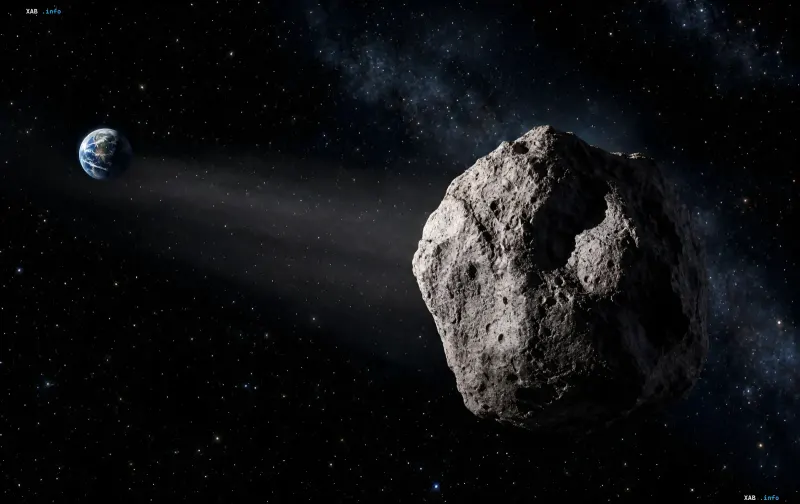
In August 2027, a large near-Earth asteroid designated 1999 AN10 will bypass Earth; it is classified by NASA as a potentially hazardous space object. According to the agency, the maximum approach will occur on August 7, 2027, at 7:12 UTC. At that moment, the distance between the asteroid and our planet will be approximately 389,855 km — a distance comparable to Earth's usual separation from the Moon.
What is 1999 AN10 and Why It Is Tracked
The asteroid was discovered on January 13, 1999, and belongs to the Apollo group. This means its elongated orbit crosses Earth's orbit around the Sun, and the object completes a full revolution in 643 days. It is this combination of body size and orbital characteristics that allows it to periodically approach Earth's orbit to a distance of less than 0.05 astronomical units, which is the criterion for inclusion in the list of potentially hazardous objects.
Flyby Parameters: Date, Distance, Visibility
Due to the relatively close flyby, asteroid 1999 AN10 will be visible in the night sky even through standard binoculars. At the moment of maximum approach, it will be located in the sky near the constellations Taurus, Aries, Pisces, and Pegasus. At the same time, the Moon during this period will be on the opposite side of Earth — at a distance of over 763,000 kilometers from the asteroid — so there is no risk of collision with the planet's satellite either.
The "Potentially Hazardous" Status Is Not a Sentence
It is important to understand that assigning an object a potentially hazardous status does not mean a collision is inevitable or even probable. This indicator merely indicates that the body is large enough and capable of flying close to Earth, so its movement must be systematically monitored. Currently, the probability of 1999 AN10 colliding with Earth is estimated to be zero.
Context: Databases and Other Asteroids
Astronomers' databases contain about 2.5 thousand potentially hazardous asteroids, although experts estimate that only about half of them have been discovered. Among other notable objects are Apophis (99942), which will fly by on April 13, 2029, at a distance of about 32,000 km from Earth's surface; Bennu (101955), which has a small potential probability of collision on September 24, 2182, and whose samples were delivered to Earth by the OSIRIS-REx mission; and 1997 XF11, early calculations for which caused concern, but subsequent observations completely ruled out the risk. The case of 1999 AN10 fits into this same picture: regular monitoring makes it possible to calculate trajectories in advance and calmly plan observations.